Mimi Zeiger

Critic, editor, curator and instigator.

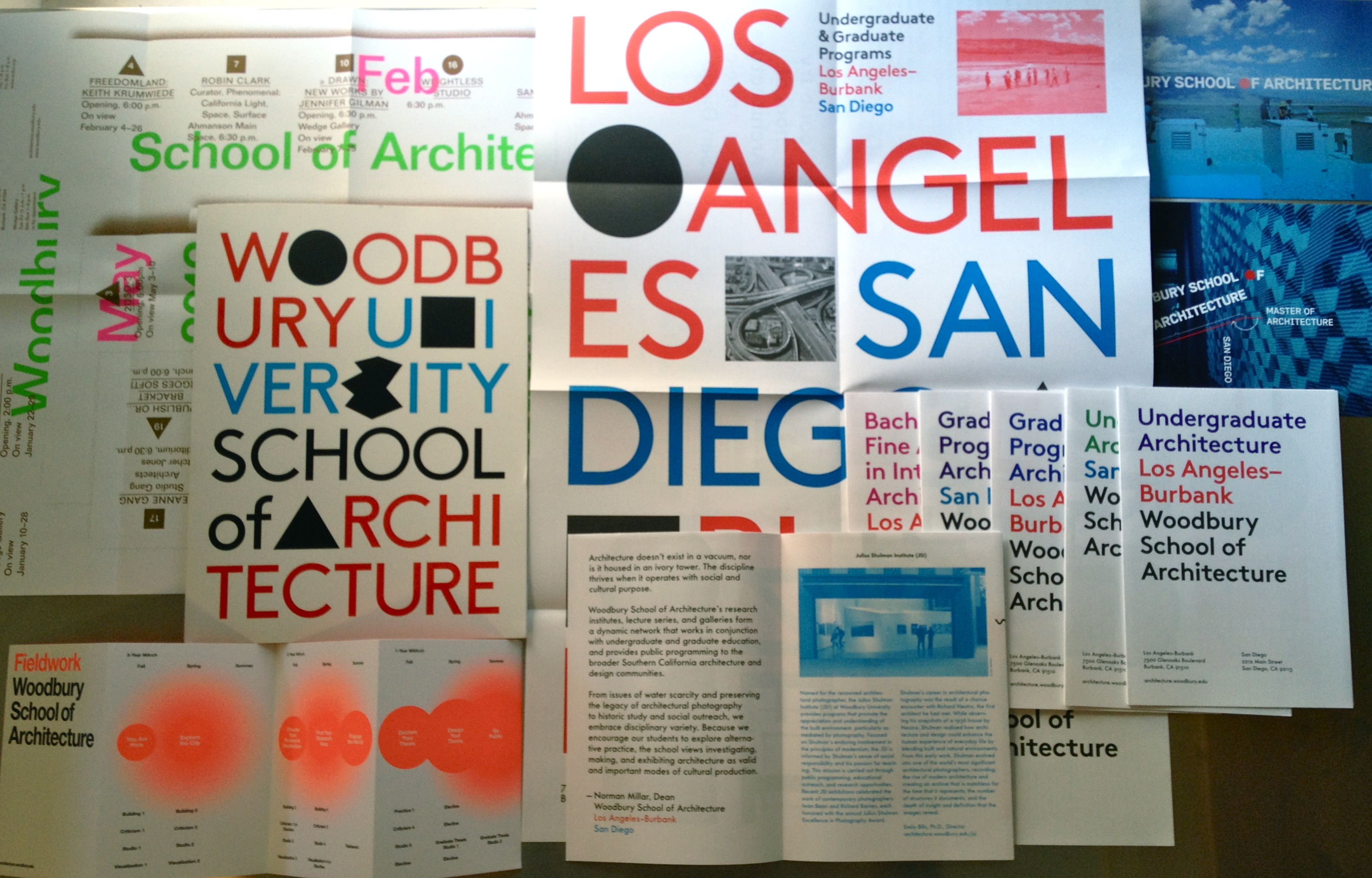
Woodbury School of Architecture’s visual identity is a system of fonts, colors, and typographic parameters. As such, there is no singular logo, but a series of graphic processes that evolve with each designer. Design ideas are passed from one designer to another in a kind of “exquisite corpse” game.

Color are bold and saturated, with cyan, red, and black at the core of the palette. Other primary brights and fluorescents are also included. Fonts are constrained to san serif families, such as Helvetica, Futura DB Brown, and Wedding.

Within this system there is a play between the white space of the page and geometric shapes, beginning with the Platonic solids: squares, circles, triangles. Other shapes are introduced as counterpoints of difference and complexity to these ideal forms. Additionally, there references to Los Angeles iconic artists John Baldessari and Ed Rusha are encouraged.

The goal is to create a design direction that is both playful and rigorous. It celebrates the building blocks and complexity of architectural design. Image choices focus on thinking through making and process, with an emphasis on students in the architectural educational environment and on site visits in order to underscore the importance of Southern California as place rich in design history and inspiration.

graphic designers
Luke Bulman, Thumb Projects
Juliette Bellocq, Handbuilt Studio
Glen Cummings, MTWTF
Neil Donnelly
Forest Graham
Mike Manalo, Rare Studio
Mark Owens, The Life of the Mind
Nick Steinhardt, 23inc
There’s nothing that so thoroughly represents the sweet spot between culture and consumption in our current zeitgeist than the pop-up. Cheap, flexible, and low-risk, it’s the go-to model for galleries, shops (both entrepreneurial DIY and haute retail brands), and restaurants. Pop-ups mushroom in New York, London, and Berlin, even as economic bubbles burst. When retail vacancy rates hit soaring heights in 2009, the pop-up went from being a strategic action practiced by arts groups to a global phenomenon embraced by entrepreneurial types and corporate brands alike. Arts organization No Longer Empty may install contemporary art exhibitions in vacated storefronts, but their pop-up mission was dwarfed in scale last holiday season when Toys R Us opened 600 temporary 2,500 square foot stores across the country—a total of 1.5 million square feet of provisional real estate. Read More …

A squat retail building in New Orleans’ Marigny neighborhood sits empty. Delta Countertops & Cabinets, its last tenants, are long gone, and the storefront is tagged with graffiti, including baby blue cursive spelling out “Sauce!” A glossy poster, roughly two-feet-high by four-feet-wide, hangs off center on the metal siding. The poster features a cheery illustration that might portend new development — housing, perhaps, or a revived commercial strip to replace the down-on-its-luck building? Closer inspection of the colorful rendering reveals a new future for the rundown structure. In the illustration the building is transformed into an ersatz mobile grocery. It’s raised high in the air and mounted on the back of a pickup; there’s a cascade of jumbo shrimp tumbling out of it. Airborne bananas and giant carrot-shaped street benches add to a festive composition. In the upper right hand corner is a logo and the enigmatic words: The Hypothetical Development Organization.

The poster is fiction.

But it is also a commentary on the need for grocery stores in underserved communities. Conceived by graphic designer/urban planner Candy Chang, and entitled Mobile Cornucopia, it is a piece in the new collective art project, The Hypothetical Development Organization (H.D.O.). Read More …

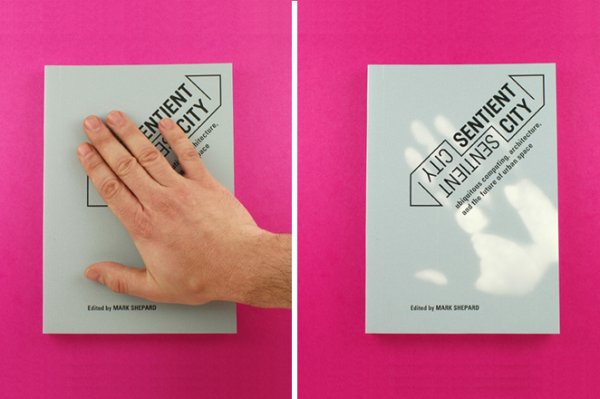
Essay: “Comforts, Crisis, and The Rise of DIY Urbanism” in Sentient City: Ubiquitous Computing, Architecture and the Future of Public Space, edited by Mark Shepard.

Sentient City: ubiquitous computing, architecture and the future of public space is an edited volume of case studies and essays that critically address the evolving relations between contemporary technologies and urban life.

This book expands on an exhibition that I curated in the fall of 2009 titled Toward the Sentient City. Documentation (text, images, diagrams, photographs) of the projects realized for the exhibition is combined with that of preliminary experiments, background research, material studies, interaction prototypes, and the subsequent analysis and interpretation of the data generated by the projects’ implementation.

Complementing these case studies, a series of critical essays reflect on the larger implications of ubiquitous computing for the way we think about architecture in general and the design of urban space in particular. Building on a series of responses to the exhibition contributed by writers and theorists of architecture, urbanism, media theory, technology and related fields, these critical reflections are intended to help the reader situate what may at first appear to be novel questions about the intersection of ubiquitous computing, architecture and urban space in terms of more long-standing and established discourses on the technological mediation of urban life and the role architects, urban designers, and technologists alike might play in shaping its future evolution.

Case studies by David Benjamin, Soo-in Yang, and Natalie Jeremijenko; Haque Design + Research; SENSEable City Lab; David Jimison and JooYoun Paek; and Anthony Townsend, Antonina Simeti, Dana Spiegel, Laura Forlano, and Tony Bacigalupo.

Essays by Keller Easterling, Matthew Fuller, Anne Galloway, Dan Hill, Omar Khan, Saskia Sassen, Trebor Scholz, Hadas Steiner, Kazys Varnelis, Martijn de Waal, and Mimi Zeiger.

Published by the Architectural League of New York and MIT Press.

Design USA: Contemporary Innovation is a retrospective of American invention. The exhibition, which opened last month at the Cooper-Hewitt National Design Museum, and coincided with the fourth annual National Design Week, marks ten years of the National Design Awards program. Organizers Jeannie Kim, National Design Awards manager, and associate curator Floramae McCarron-Cates, present 78 award winners in the Cooper-Hewitt’s ground-floor galleries. It is a straightforward conceit: Design USA looks backward in order to look forward. Read More …