Mimi Zeiger

Critic, editor, curator and instigator.

At the heart of Exhibit Columbus, a biennial-like exhibition of 17 architectural installations and pavilions that runs through November 26, lies the question: “What can architecture do for a community?” The community in question is Columbus, Ind., known as the birthplace of Vice President Mike Pence, the home to diesel engine manufacturer Cummins, Inc. (the region’s largest employer), and, most prominently, the site of industrialist and philanthropist (and former Cummins chair) J. Irwin Miller’s experiment in municipal modernism. Read More …

New Yorkers find it hard to understand Los Angeles. They extol the beach and weather, but sneer at the traffic and cheesy Hollywood Boulevard. Intrepid visitors might find nirvana on Mulholland Drive or in an order of tacos al pastor, but few get the, to use a very LA word, vibe. Writing in the 1970s, Eve Babitz – artist, author, party girl, Angeleno – once chided a visitor from the East Coast for being so at odds with the city’s pace. ‘And he wore ties, even on weekends,’ she scoffed.

Which is why it’s such a surprise to find David Alhadeff – quintessential New Yorker, founder of Manhattan design gallery and store The Future Perfect, and described by The New York Times as the original ‘fulcrum’ of the Brooklyn design movement — sitting tieless in the kitchen of his midcentury modern Hollywood home. His laptop is open; he’s on the phone. Still, he seems relaxed. The breakfast nook of Casa Perfect is his West Coast office. It overlooks the pool, a David Hockney painting waiting to happen. Read More …

How one responds to the exhibition now on view at SCI-Arc may very well depend on the ability to distinguish between a duck and a swan. “The Duck and the Document: True Stories of Postmodern Procedures” begins with a wall-sized construction drawing for a fountain in the forecourt of Michael Graves’ Disney World Swan and Dolphin Hotel in Orlando. The drawing at first seems to be a graphic representation of Robert Venturi, FAIA, and Denise Scott Brown, Hon. FAIA’s definition of “duck”: an emblem of architecture’s most valiant form-making impulses. Read More …

On Saturday, October 22, from 11am-3pm, the Architecture Lobby will host a “Think-In” at UCLA, where invited panelists and a professional facilitator will critically debate and discuss topics most integral to the aims of the Architecture Lobby, including: architecture labor and labor rights, the pros/cons of professionalization, the perceptions of architects within the media, and emerging pedagogical models. The Think-In is free and open to the public, and all interested students, academics, or practitioners are strongly encouraged to join the discussion.

Panelists:
Frances Anderton, KCRW (DnA, Design and Architecture)
Wil Carson, 64North, UCLA
Peggy Deamer, Yale University and The Architecture Lobby
Jia Gu, Materials & Applications, The Architecture Lobby
Tia Koonse, UCLA Labor Center
Elizabeth Timme, LA-Más
Mimi Zeiger, critic and curator, Art Center College of Design, The Architecture Lobby
Peter Zellner, ZELLNERandCompany, USC, Free School of Architecture
Facilitator: Nancy Alexander

What is disruption, anyway? The term has been cast as a tech market tactic, a cultural trope, and a belief system of near-theological proportions. In an evening of performances and provocations, we considered many definitions of this watchword. Presenters offered perspectives of radical change ranging from activism and technology to equity and design:

Participants: It’s Showtime NYC subway dancers; Kimberly Drew, @museummammy and associate online community producer, The Metropolitan Museum of Art; Riley Hooker, editor, Façadomy; E. Tammy Kim, editorial staffer, The New Yorker, Jonathan Lee, design manager/lead, Google Design; Oscar Nuñez, program coordinator, Center for Urban Pedagogy; members of Picture the Homeless; Steven Thrasher, U.S. writer-at-large, The Guardian; and critic, editor, and curator Mimi Zeiger

A collaboration between Mimi Zeiger and Neil Donnelly

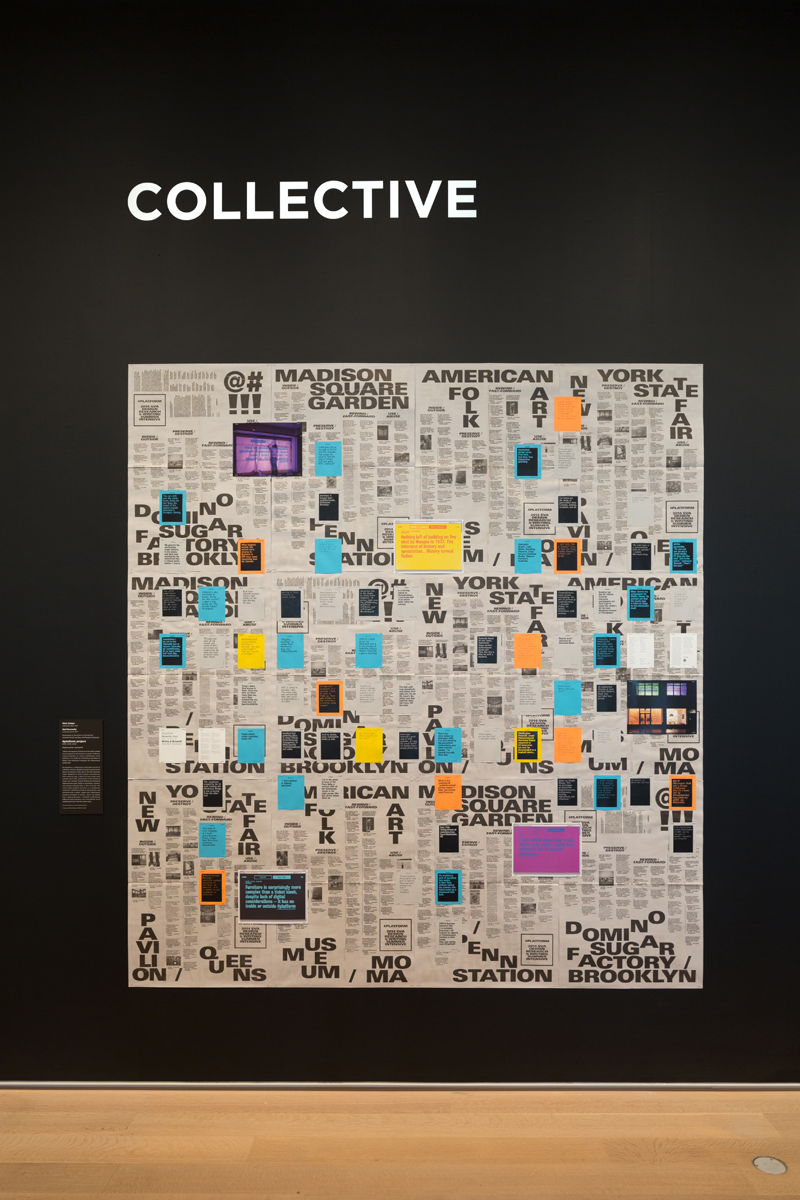
#platform is both a means of production and a place to take a stand.

#platform project is a collaborative publication and act of collective criticism.

#platform’s physical documents navigate back into the city, lingering as messages.

For the past four years, participants in the School of Visual Arts Summer Design Writing and Research Intensive in New York have used Twitter to document, research, and critique the city. The social media platform acts as a productive constraint, distilling individual observations and narratives into a public, digital text. Read More …

The gesture was more graceful than the act. With one generous flick of the wrist I sent the paperback sailing across the room. The book, The Age of Earthquakes: A Guide to the Extreme Present, is a small volume tri-authored by an intellectual supergroup: novelist and artist Douglas Coupland, international curator Hans Ulrich Obrist, and cultural critic Shumon Basar. In wry deference to its subject, the cover is inked in an oil slick chromo metallic. As Earthquakes arced from the couch to the closet door, which it hit with a thud before dropping to the floor, light reflected off its glistening surface, giving the appearance of a salmon spawning upstream.

(For the record, S,M,L,XL also boasts a silver cover, but I can’t imagine throwing the six-pound tome very far. Earthquakes, by contrast, is lightweight at 7.8 ounces).

When it landed, facedown, pages splayed and pressed against the floor, the half-light of the living room lamps seemed to illuminate a mysterious object. An alien ship crash-landed on oak boards. And so it sat there for a few days. Until my irritation with leaving a book on the floor trumped my irritation with the book itself and I picked it up. Read More …

Curators: Karen Kice, with Iker Gil

Mimi Zeiger and Neil Donnelly with the School of Visual Arts Summer Design Writing and Research Intensive

Architecture is a perpetual conversation between the present and the past, knowing full well that the future is listening. So what happens when this dialogue is influenced by contemporary modes of communication such as texting, Twitter, and Instagram? Chatter happens: ideas are developed, produced, and presented as open-ended or fragmented conversations and cohere through the aggregation of materials. Chatter: Architecture Talks Back looks at the diverse contemporary methods and approaches wielded by five emerging architects: Bureau Spectacular, Erin Besler, Fake Industries Architectural Agonism, Formlessfinder, and John Szot Studio. Read More …

On Monday, January 19, 2015, MAS Context and five LA-based contributors will provide a behind-the-scenes look at the publication and discuss the work they contributed. The event will be hosted at Bruce Mau Design Los Angeles.

Contributors:
Julia Luke (Creative Director, Julia Luke Design)
Deborah Richmond (Architect, Deborah Richmond Architects)
Joshua G. Stein (Architect, Radical Craft)
David Yoon (Engineer, YoonCo)
Mimi Zeiger (Critic, editor, curator and instigator)

Moderated by Iker Gil (Editor-in-chief, MAS Context) and Andrew Clark (Director, BMD Los Angeles).

Barbara Bestor (architect and executive director of the Woodbury University Julius Shulman Institute) moderates a panel on the critical and engaged eye that photographers bring to the built environment. In LA the human experience of space has undergone constant transformation and we will discuss the urban environment and its changing representations.

Moderator: Barbara Bestor: Architect and Executive Director of the Woodbury University Julius Shulman Institute

Panelists:
Frances Anderton: Producer, Writer & Host of DnA, Design & Architecture, KCRW
James Welling: Artist & Professor of Photography, UCLA Department of Art
Mimi Zeiger: Critic, Editor & Writer
Grant Mudford: Photographer
Gordon Baldwin: Independent Curator, Writer & Editor, Former Curator
Department of Photographs, Getty Museum