Mimi Zeiger

Critic, editor, curator and instigator.

“Reality, however utopian, is something from which people feel the need of taking pretty frequent holidays,” wrote Aldous Huxley in his 1932 dystopian novel Brave New World, and the sentiment is acute nearly 90 years later. The pandemic has intensified and accelerated a digital drift, as culture turns to the virtual— to Zoom, Animal Crossing, or TikTok—for ways to escape and normalize current conditions. Going on a reality holiday, however, risks setting up a needless opposition between activities in our daily lives and our online interactions. The truth is that we are all operating somewhere in between—and it is this middle ground where a number of emerging artists, architects, and designers are staking out territory, using this nonbinary space to address questions of subjectivity and identity.

Read More …

The works of artist, educator, and social justice activist Corita Kent are packed with slogans and scripture. Her silk-screen posters from the 1960s and ’70s crackle with the energy of a time of social unrest. She pulled text and images from advertising and media, recombining them into compositions reflecting on the Civil Rights and peace movements.

“GET WITH THE ACTION,” demands a 1965 silk-screen titled for emergency use soft shoulder, its primary colors reminiscent of Wonder Bread packaging. “HOPE AROUSES AS NOTHING ELSE CAN AROUSE A PASSION FOR THE POSSIBLE,” says another piece from 1969 in black block letters on a bright-yellow field. Kent’s Pop art style is often compared to that of Andy Warhol— whose paintings of soup cans she saw in 1962 at Ferus Gallery in Los Angeles—often as defense of her legitimate claim to be part of the canon. Yet while the more famous artist traded in a cosmopolitan deadpan, Kent’s practice reflected her Catholic beliefs and humanity.

Read More …

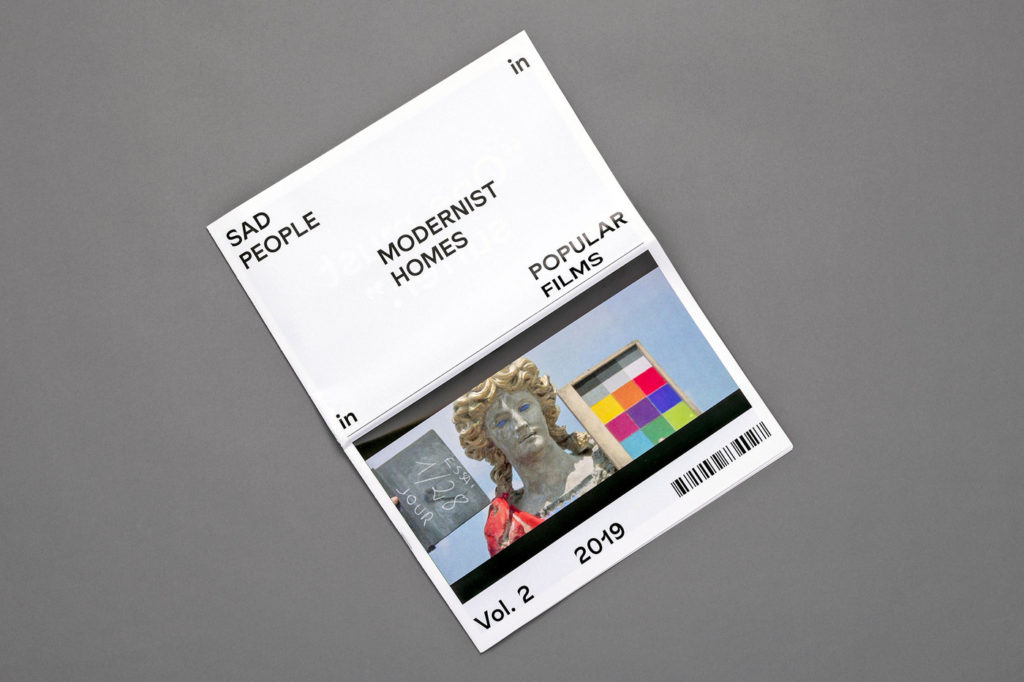
The long-awaited follow-up to the now-canonical ‘Evil People in Modernist Homes in Popular Films’ (2010), ‘Sad People’ examines the filmic trope of housing unhappy characters inside of modernist architecture.

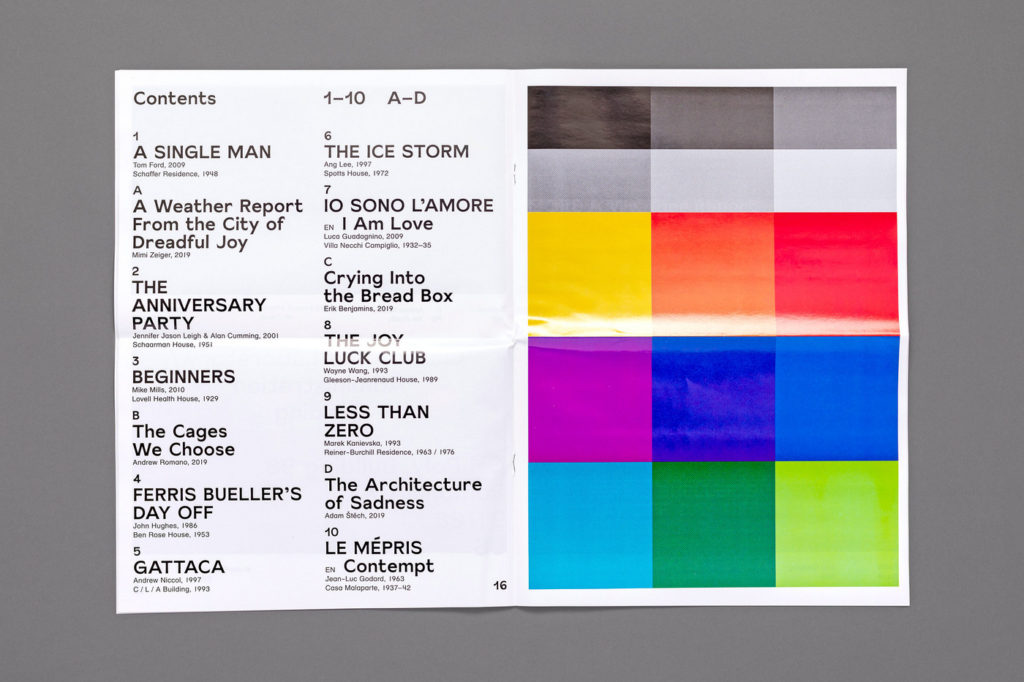
Case studies via ten characters / homes / films, from Colin Firth’s George Falconer inside John Lautner’s Schaffer Residence in Tom Ford’s ‘A Single Man’ (2009) to Brigitte Bardot’s Camille Javal inside Adalberto Libera’s Casa Malaparte in Jean-Luc Godard’s ‘Le Mépris’ (1963).

Essays by Erik Benjamins, Andrew Romano, Adam Štěch (Okolo), and Mimi Zeiger. Ed. by Benjamin Critton.

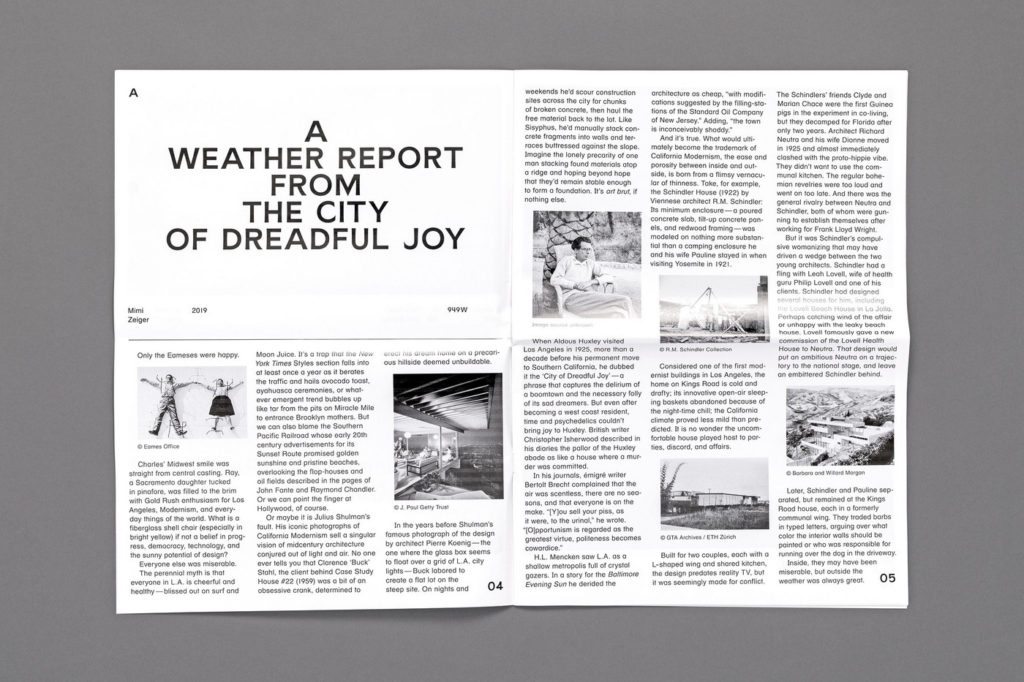
A Weather Report from the City of Dreadful Joy

Only the Eameses were happy.

Charles’ Midwest smile was straight from central casting. Ray, a Sacramento daughter tucked in pinafore, was filled to the brim with Gold Rush enthusiasm for Los Angeles, Modernism, and everyday things of the world. What is a fiberglass shell chair (especially in bright yellow or aquamarine) if not a belief in progress, democracy, technology, and the sunny potential of design?

Everyone else was miserable.

Read More …

In fall 2020, the Wolfsonian Public Humanities Lab sponsored a six-episode series titled Whither Criticism? to question the state of architecture criticism today, and to ask how the field needs to adapt to address the major crises of our time.

Hosts David Rifkind (Architecture) and Dan Evans (Journalism + Media) welcomed some of the leading architecture critics of our time for a frank and illuminating discussion. Speakers included Lee Bey, Christopher Hawthorne, Inga Saffron, Kate Wagner, Alistair Gordon, and Mimi Zeiger.

Read More …

The 2020 Exhibit Columbus Symposium: New Middles gathered national and international thought leaders in architecture, art, design, and landscape architecture together with Columbus stakeholders to explore the question, What Is The Future of The Middle City?

Read More …

Joar Nango’s identity as Sámi, the Indigenous people of northern Europe, is central to his art and architecture practice. Yet in terms of discipline or medium, he actively defies categorization, choosing instead to mobilize the space in-between and across worlds. This is partly to find breathing room within his creative practice and partly political stance — strategic evasion as post-capitalist critique. Through site-specific installations, video, and zines, Nango actively investigates intersections between Indigenous and contemporary architectures, traditional Sámi construction, and new media. The results have a way of escaping the present; instead, they create a kind of feedback loop between past and future architectural narratives. 

Read More …

I can’t stop thinking about refugia. In the years, months, and days before the COVID-19 pandemic, the term was confined to the literature and philosophy of climate crisis, referring to pockets of life that through geographic isolation or species resilience manage to hang on in spite of the environmental forces against them. Think of clusters of Pacific Northwest barnacles nestled high on coastal outcroppings to avoid falling prey to sea snails. Or old-growth forests insulated from rising temperatures in cool mountain valleys.

As self-quarantine set in earlier this spring, the word refugia, at least for me, expanded in definition from specific ecological condition to conceptual touchstone—a necessary leap to metaphor when faced with planetary crisis. The magnitude of this pandemic falls outside human comprehension, but for the luckiest of us, refuge is manageable: a place of relative safety, of sourdough starters and online Jazzercise classes.

Read More …

“LACMA belongs to the people of Los Angeles County and it should reflect the tremendous diversity, creativity, and openness to change that can be found here,” reads a headline on the buildinglacma.org, a website ostensibly tracking the design and construction of the controversial, squiggle of a proposal by Swiss architect Zumthor.

Such marketing copy, written by the voice of Los Angeles County Museum of Art (LACMA) director Michael Govan, is meant to rally support (public and financial) under a banner of shared values. But that last phrase – openness to change that can be found here – is suspect on two accounts.

Read More …

Reading Countryside, A Report, a book of essays on rural areas by the Dutch architect and his research studio AMO, during the time of Covid-19 is like trying to learn to swim by watching a goldfish.

Produced as a catalogue to accompany the currently shuttered exhibition Countryside, The Future at New York’s Guggenheim museum, the small paperback has a silver foil cover designed by Irma Boom that glints appealingly as it catches the light. The words “Countryside in your pocket! $24.95” advertise an accessible price point.

Read More …