There are some unexpected pairings at Street, the restaurant recently opened in Los Angeles by the chef Susan Feniger. Take, for example, the menu, which draws on pushcart offerings from around the world: Korean mung-bean pancakes and Thai curries face off but don’t fuse. The least likely union, however, has to be between Feniger, famed as a co-owner of the Border Grill and a co-host of the 1990s Food Network show Too Hot Tamales, and Street’s architect, the coolly cerebral Neil Denari. Read More …
DOMINIQUE CAMACHO is passionate about the old architecture of the East Village. She holds sustainability workshops, supports preservation as a member of the East Village Community Coalition and, for much of the past 15 years, has gazed enviously at a former synagogue on East Seventh Street. Read More …

With “McMansions” increasingly giving way to “tiny” houses, the desire to downsize and be more ecologically and economically prudent is a concept many are beginning to embrace. Focusing on dwelling spaces all under 1,000 square feet, TINY HOUSES (Rizzoli, April 2009) aims to challenge readers to take a look at their own homes and consider how much space they actively use.
Ranging from tree houses to floating houses, TINY HOUSES features an international collection of over thirty modular and prefab homes, each one embodying “microgreen living”, defined as the creation of tiny homes where people challenge themselves to live “greener” lives. By using a thoughtful application of green living principles, renewable resources for construction, and clever ingenuity, these homes exemplify sustainable living at its best.
On Feb. 19, President Barack Obama signed an order establishing the White House Office of Urban Affairs. First announced just days after the historic U.S. election last November, the office—which will be headed by Bronx Borough president Adolfo Carrión Jr., who has a master’s in urban planning and spent three years in the New York City Department of City Planning—will serve as a bridge between federal dollars and the programs that affect metropolitan America. Among other pursuits, its mandate covers community development, housing, job creation, manufacturing innovation, sustainable technologies, and infrastructure. Read More …
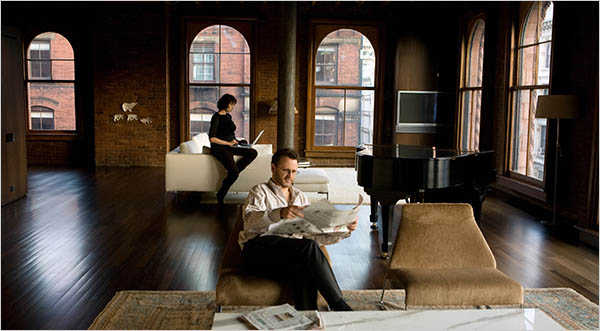
NATALYA KASHPER sat in her minimalist living room, a light-filled space made rich with rough brick walls, a sculptural masonry fireplace and wooden ceiling joists. She looked out of the arched windows, framed in deep wood casements, and took in the view.
“I remember coming to SoHo with my mom and thinking, ‘This is so beautiful,’ ” said Ms. Kashper, who grew up in California. “SoHo is the epitome of an old American city.” Read More …
Fans of Pin-Up, the gold-covered New York-based publication that mixes architecture and bondage at will, will be pleased to note that it comes out of a long line of magazines, available via the mail but not necessarily naughty. Mimi Zeiger is a self-described “old zinester,” who printed the first issue of her zine about architecture, loudpaper, as a graduate student at the Southern California Institute of Architecture. It was her graduate thesis, and she printed it on paper from de-commissioned maps and put a picture of Elvis on top. More recently, Zeiger added an online component, her blog; now she is re-visiting zine history with A Few Zines, an exhibition that opens tonight at Columbia’s Studio X.
Upon its publication in 1996, loud paper joined Lackluster, Infiltration, Dodge City Journal, and Monorail as alternatives to trade and academic journals by mixing architecture and pop culture and cultivating a social aspect. To hear Zeiger tell it, publishing architecture zines was part of a vital network of sub-cultures. Zeiger’s was her interest in the Indie music scene: “You couldn’t miss it,” she says, “I was more of arty kid than a punk rock kid. You found your way through sub-cultures.” She compares the types of connections to a Facebook network today, as a community where acquaintances for whom it was relatively easy to reach out. It also brought advertisers together with writers; “Ads were part of the editorial” says Zeiger, describing ads for Dischord Records laid out alongside MIT Press. People have stayed involved, opening magazines of significant distribution like Dwell and American Craft.
Richly-colored canvases line the walls of architect Victor Lundy’s hangar-like studio in Houston, Texas. Some 50 feet wide and 65 feet long, there is ample room to make art and houses his de facto archive. Shelved are battlefield sketchbooks from his WWII service as are numerous magazine clippings featuring the architect’s designs. Over his career Lundy’s designed churches and embassies, houses and, even, inflatable structures. Practicing since the early 1950s, he still picks up the occasional house commission and paints daily. At 85, he has a restless creativity. “These days I am thinking a lot and I am on a verge of a breakthrough,” Lundy says over the phone. “I want to invent something, but it is hard. Every time I paint, the rectangle is a limiting thing. Being an architect, everything I paint is seems less important than the space I make.” The architect’s vision is grander than the canvas. It always has been. Read More …
The architect never studied with the masters, but his work was a radical reaction to the Colorado environment, and an expression of futuristic ideals.
Joel Haertling, son and de facto archivist of the late architect Charles A. Haertling, faxed over a single page written by his father. Titled “Thoughts on Architecture,” it’s a blurry, typewritten list. Charles Haertling succumbed to a brain tumor in 1984, but the text is immediate and cuts across the years: 21 enumerated glimpses into a creative mind. Someone has circled point number 14: “Design is always a tortuous, grueling, almost maddening, though heavenly sweet, task.” The line is as familiar as it is revealing. Look at Haertling’s houses with their radically pitched roofs, daring cantilevers, and mushrooming facades—products of a career spent building in the Boulder, Colorado, area—and you can see both his pleasure and his pain.
“I was never an architect’s architect. I’m too impatient. I just can’t wait around for years for a building to get built,” says New Orleans sculptor Laurel Porcari. Her preferred medium, kiln-formed glass, is hot, heavy, and dirty, but immediate—a far cry from CAD drawings. Nevertheless, her pieces, cast so that the material flows and warps to take on textures or resemble landscapes, capture an architect’s sensibility. After receiving her Master of Science in architecture. from Columbia in 1993, Porcari headed for Australia, where she taught design in both Perth and Melbourne. She was also working in plastic, hand-printing abstract maps on acrylic sheets to create art installations. Returning to the States, she landed in New Orleans to study in the urban design Ph.D. program at Tulane University.*
“I was never an architect’s architect. I’m too impatient. I just can’t wait around for years for a building to get built,” says New Orleans sculptor Laurel Porcari. Her preferred medium, kiln-formed glass, is hot, heavy, and dirty, but immediate—a far cry from CAD drawings. Nevertheless, her pieces, cast so that the material flows and warps to take on textures or resemble landscapes, capture an architect’s sensibility. After receiving her Master of Science in architecture. from Columbia in 1993, Porcari headed for Australia, where she taught design in both Perth and Melbourne. She was also working in plastic, hand-printing abstract maps on acrylic sheets to create art installations. Returning to the States, she landed in New Orleans to study in the urban design Ph.D. program at Tulane University.*