Mimi Zeiger

Critic, editor, curator and instigator.

Early evening Mid-city.

I’m driving westward down 3rd. Street. Not avenue. An ambitious, if under represented, Los Angeles artery. Beginning a few blocks away from Occupy LA, 3rd Street runs boldly for several miles from Downtown to Beverly Hills, an offshoot of the tight grid established in the late 1800s. Then it stops short. Dying out with a whimper at Alpine Drive. Representing the industrialist pragmatism of 19th century urban planning, the route never makes it past the historically green lawns of the Los Angeles Country Club—the club, in its 1911 location, is a pastoral parable in aspirational living. Ronald Regan was a member. Read More …

The living city. It’s a phrase or a variation on a phrase you’ve probably heard dozens of times to describe the urban realm. Perhaps we use the living descriptor because we like to anthropomorphize evolutionary processes; take Jane Jacobs’s iconic title The Death and Life of Great American Cities as an example. Or maybe it’s because cities are seething with people—the churn of humanity on the streets. Here, we can look to The Social Life of Small Urban Spaces, William H. Whyte’s seminal sociological study of public space for a titular equivalent. For sure, the life metaphor has sparked imaginative discourse: cities walk (Archigram) and go a bit mad (Koolhaas), but as digital devices and technological infrastructures increasingly mediate the way we live in cities, the language by which we describe urbanism shifts accordingly. The city is less akin to organisms and more to software, thus subject to coding, versioning, and hacking, like any computer program. Read More …

“California design is not a superimposed style, but an answer to present conditions….It has developed out of our own preferences for living in a modern way,” explained architect and designer Greta Magnusson Grossman in 1951. Casually, she captured the essence of midcentury West Coast design—a movement built on climatic, economic, and technological responses to Los Angeles combined with a non-doctrinaire embrace of modernism. It’s her quote that opens California Design, 1930–1965: “Living in a Modern Way,” the latest exhibition at the Los Angeles County Museum of Art (LACMA). Read More …

Edited by Elias Redstone

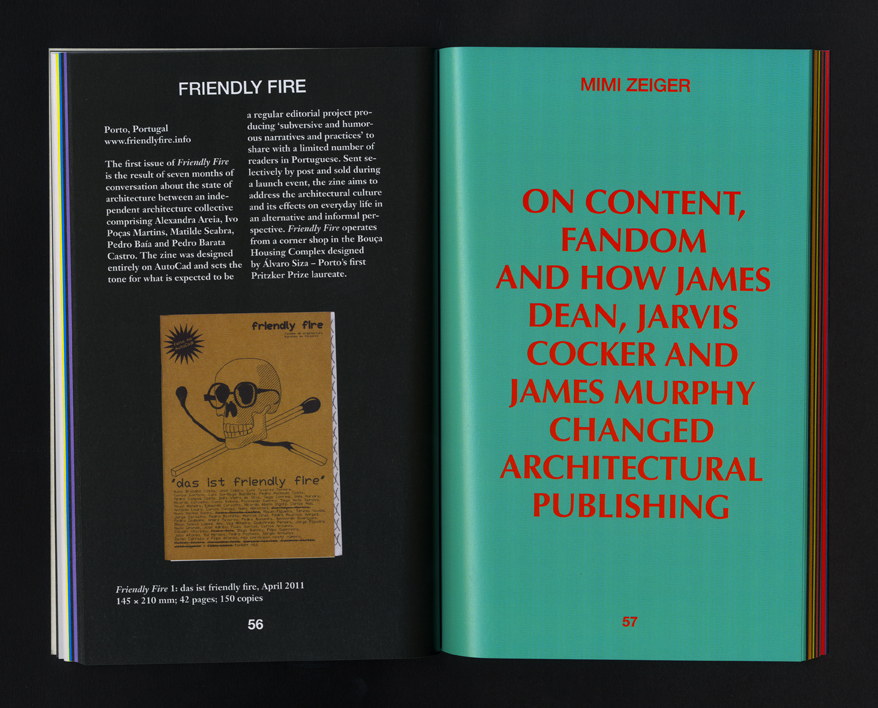
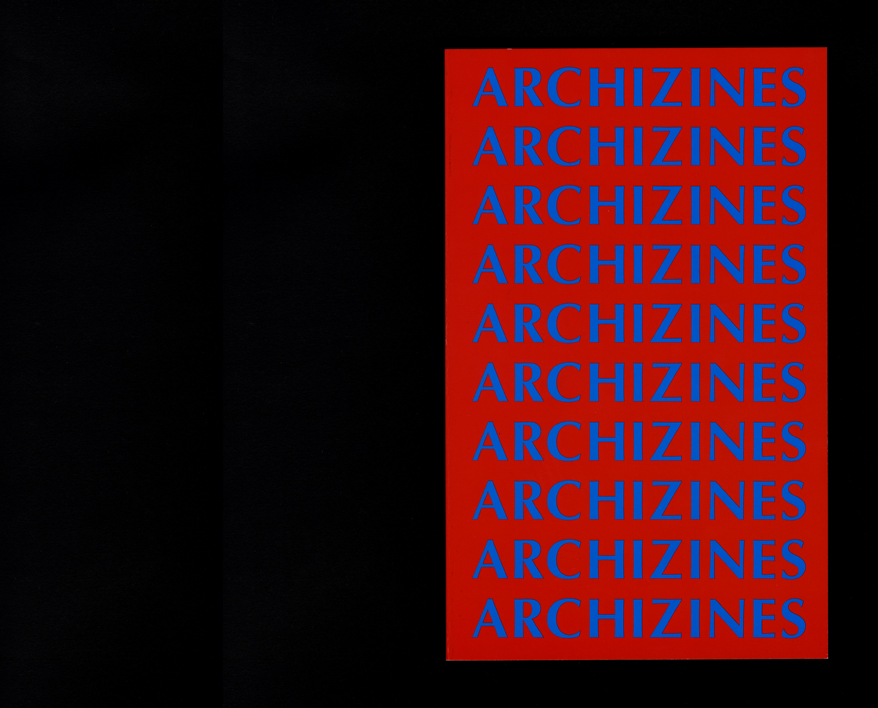
From handmade fanzines and print-on-demand news-letters to magazines and student journals, ARCHIZINES celebrates the recent resurgence of alternative and independent architectural publishing. Edited by Elias Redstone, ARCHIZINES showcases 60 new publications from over 20 countries alongside critical texts from Pedro Gadanho (Beyond), Iker Gil (MAS Context), Adam Murray (Preston is my Paris), Rob Wilson (Block), Mimi Zeiger (Maximum Maxim MMX / loudpaper) and Matthew Clarke, Ang Li & Matthew Storrie (PIDGIN) that explore the relationship between architecture and publishing today. Themes addressed include the role of publishing in academia and architectural practice, and the representation of architecture in fictional writing, photography, magazines and fanzine culture. Read More …

There’s nothing that so thoroughly represents the sweet spot between culture and consumption in our current zeitgeist than the pop-up. Cheap, flexible, and low-risk, it’s the go-to model for galleries, shops (both entrepreneurial DIY and haute retail brands), and restaurants. Pop-ups mushroom in New York, London, and Berlin, even as economic bubbles burst. When retail vacancy rates hit soaring heights in 2009, the pop-up went from being a strategic action practiced by arts groups to a global phenomenon embraced by entrepreneurial types and corporate brands alike. Arts organization No Longer Empty may install contemporary art exhibitions in vacated storefronts, but their pop-up mission was dwarfed in scale last holiday season when Toys R Us opened 600 temporary 2,500 square foot stores across the country—a total of 1.5 million square feet of provisional real estate. Read More …

21st century advances in engineering and technology have lead to the creation of the most fascinating design and architectural projects ever imagined. However, in this desire for progress, we often forget about the psychological and even architectural barriers that some humans face when considering living and working in these amazing spaces.  For some people, these barriers are true obstacles, for others they become an enticing challenge to better this world of modern design to ensure that all can access and take equal enjoyment of it. The development of projects that fully consider accessibility from the initial concept stages is an important and major concern for many architects. Most important today is establishing an open communication regarding these issues and their vital importance. We bring you an interview between two prominent experts of architecture who explore the issues and advantages of pushing professionals to think in a more holistic approach to universal access.

Here, Mimi Zeiger, professor, author, founder of loud paper currently, freelance writer and contributing editor to Architect magazine, talks to Michael Graves, globally renowned architect, and household name through his designs for Target stores. Michael, after suffering a health incident that paralyzed him from the waist down, utilized his disability as a vantage point from which to create more accessible architecture and product design. Drawing from his personal experience, Mr. Graves advocates greater access to spaces and products for all humans in a relatable and functional manner that never loses the joyful touch of great design. Read More …

A squat retail building in New Orleans’ Marigny neighborhood sits empty. Delta Countertops & Cabinets, its last tenants, are long gone, and the storefront is tagged with graffiti, including baby blue cursive spelling out “Sauce!” A glossy poster, roughly two-feet-high by four-feet-wide, hangs off center on the metal siding. The poster features a cheery illustration that might portend new development — housing, perhaps, or a revived commercial strip to replace the down-on-its-luck building? Closer inspection of the colorful rendering reveals a new future for the rundown structure. In the illustration the building is transformed into an ersatz mobile grocery. It’s raised high in the air and mounted on the back of a pickup; there’s a cascade of jumbo shrimp tumbling out of it. Airborne bananas and giant carrot-shaped street benches add to a festive composition. In the upper right hand corner is a logo and the enigmatic words: The Hypothetical Development Organization.

The poster is fiction.

But it is also a commentary on the need for grocery stores in underserved communities. Conceived by graphic designer/urban planner Candy Chang, and entitled Mobile Cornucopia, it is a piece in the new collective art project, The Hypothetical Development Organization (H.D.O.). Read More …

“Ordinary life is receiving powerful impulses from a new source. Where thirty years ago architects found in the field of the popular arts techniques and formal stimuli, today we are being edged out of our traditional role by the new phenomenon of the popular arts advertising,” wrote Alison and Peter Smithson in their classic 1956 essay, “But Today We Collect Ads.” For these architects teetering on the edge of modernism it was ephemera—”the piece of paper blowing about the street, the throw-away object and the pop-package”—that was redefining the everyday. Read More …

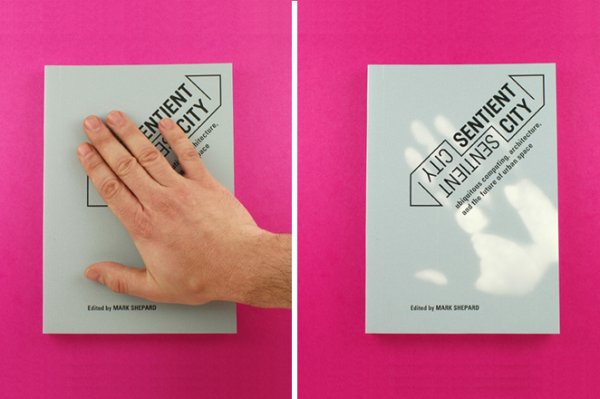
Essay: “Comforts, Crisis, and The Rise of DIY Urbanism” in Sentient City: Ubiquitous Computing, Architecture and the Future of Public Space, edited by Mark Shepard.

Sentient City: ubiquitous computing, architecture and the future of public space is an edited volume of case studies and essays that critically address the evolving relations between contemporary technologies and urban life.

This book expands on an exhibition that I curated in the fall of 2009 titled Toward the Sentient City. Documentation (text, images, diagrams, photographs) of the projects realized for the exhibition is combined with that of preliminary experiments, background research, material studies, interaction prototypes, and the subsequent analysis and interpretation of the data generated by the projects’ implementation.

Complementing these case studies, a series of critical essays reflect on the larger implications of ubiquitous computing for the way we think about architecture in general and the design of urban space in particular. Building on a series of responses to the exhibition contributed by writers and theorists of architecture, urbanism, media theory, technology and related fields, these critical reflections are intended to help the reader situate what may at first appear to be novel questions about the intersection of ubiquitous computing, architecture and urban space in terms of more long-standing and established discourses on the technological mediation of urban life and the role architects, urban designers, and technologists alike might play in shaping its future evolution.

Case studies by David Benjamin, Soo-in Yang, and Natalie Jeremijenko; Haque Design + Research; SENSEable City Lab; David Jimison and JooYoun Paek; and Anthony Townsend, Antonina Simeti, Dana Spiegel, Laura Forlano, and Tony Bacigalupo.

Essays by Keller Easterling, Matthew Fuller, Anne Galloway, Dan Hill, Omar Khan, Saskia Sassen, Trebor Scholz, Hadas Steiner, Kazys Varnelis, Martijn de Waal, and Mimi Zeiger.

Published by the Architectural League of New York and MIT Press.
It’s early afternoon when my taxi pulls up in front of a boxy clapboard building in Princeton, N.J. Michael Graves, FAIA, keeps a number of studios on this tree-lined street. I worry that I haven’t made it to the right one, especially when I’m welcomed by three wooden steps leading to a small porch. As far as I can tell, there’s no accessible ramp or lift, and I can’t ascertain how Graves—who’s used a wheelchair since 2003, when a spinal infection left him paralyzed from the chest down—gets to work. Read More …