The Bolton/Culbertson House in Pasadena wears its more than 100-year history well. Located on West Del Mar Boulevard, just off of Millionaires Row, the stately Craftsman bungalow appears seems to defy time. A herringbone brick path cuts through a trim lawn to a welcoming porch. A wide cedar door, detailed with teak insets and a stained glass window by former Tiffany Studios artisan Emil Lange, seems ready to yawn open and embrace visitors. Arcing boughs of blue cedars complete the Arts and Crafts composition. Read More …
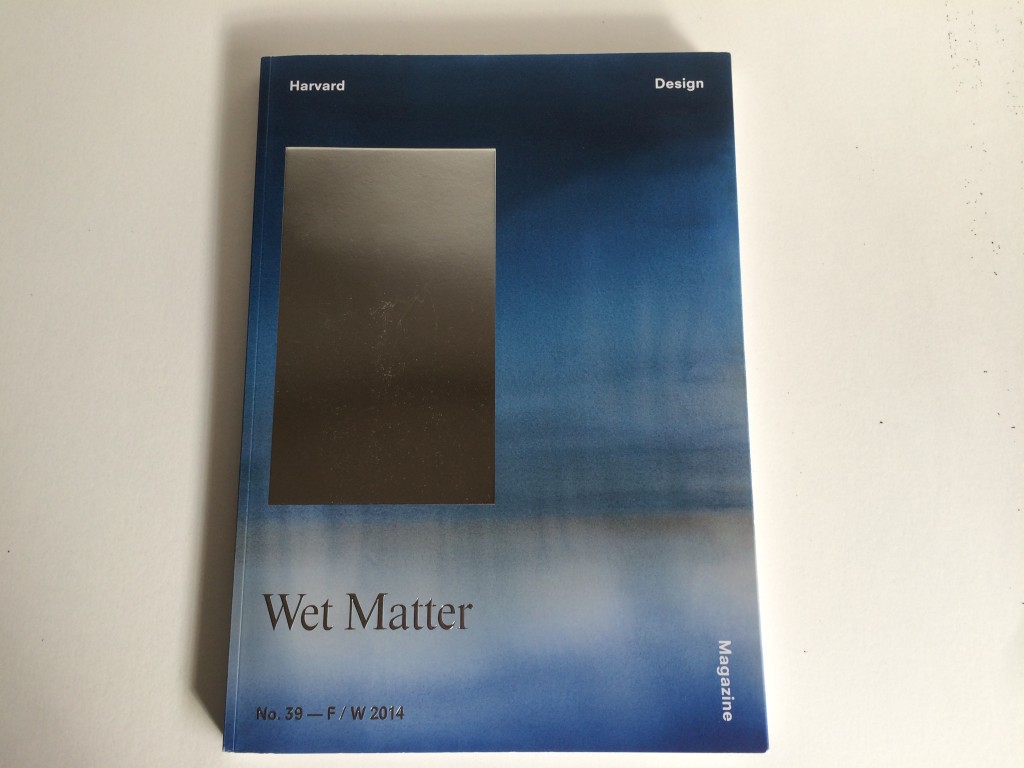
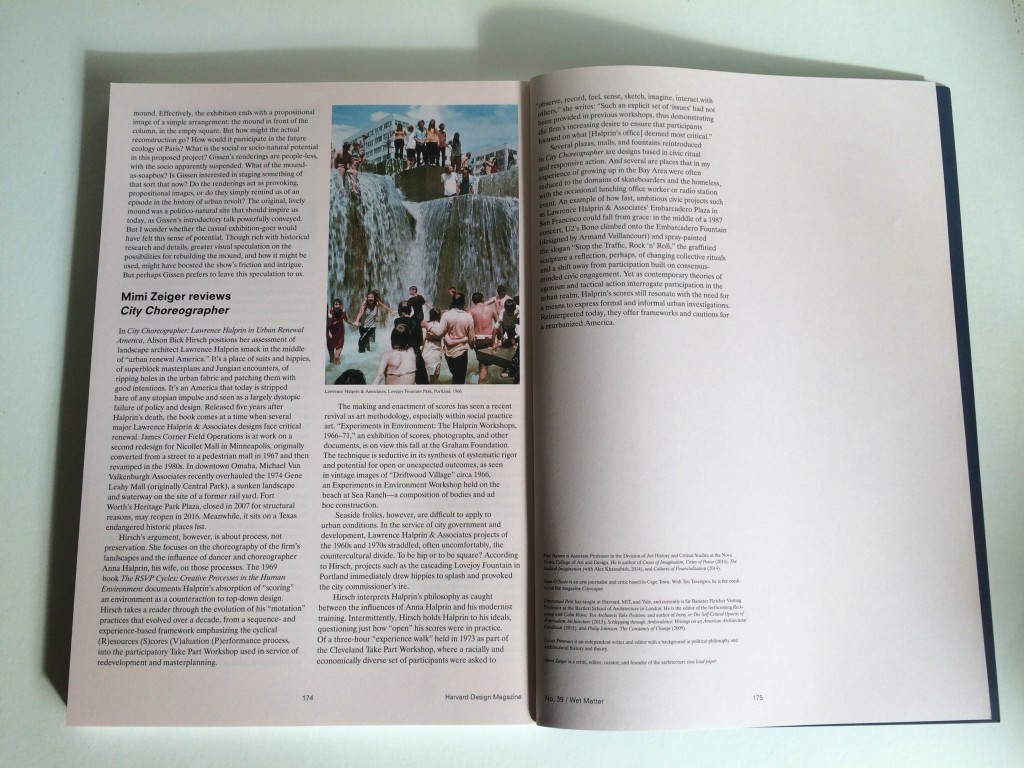
Issue No. 39, “Wet Matter”
On a hot October evening I stood on the front walk of Greene and Greene’s Gamble House in Pasadena and watched a puppet crane poke his beak through the center of what can only be described as an Arts and Crafts vortex. A nearly 30-foot-wide sculpture hung from the street façade, patterned in a hallucinogenic, Morris-style rose motif. The crane and rose are, of course, the Gamble family crest. Its author, artist Patrick Ballard, calls it The Swirling Mess Below the Sleeping Porch Soon Solidified into a Crest of Phantasmagoric Weight that Creaks Between the Doors, the Floors, and a Form that Could Never Be a House Again. Read More …
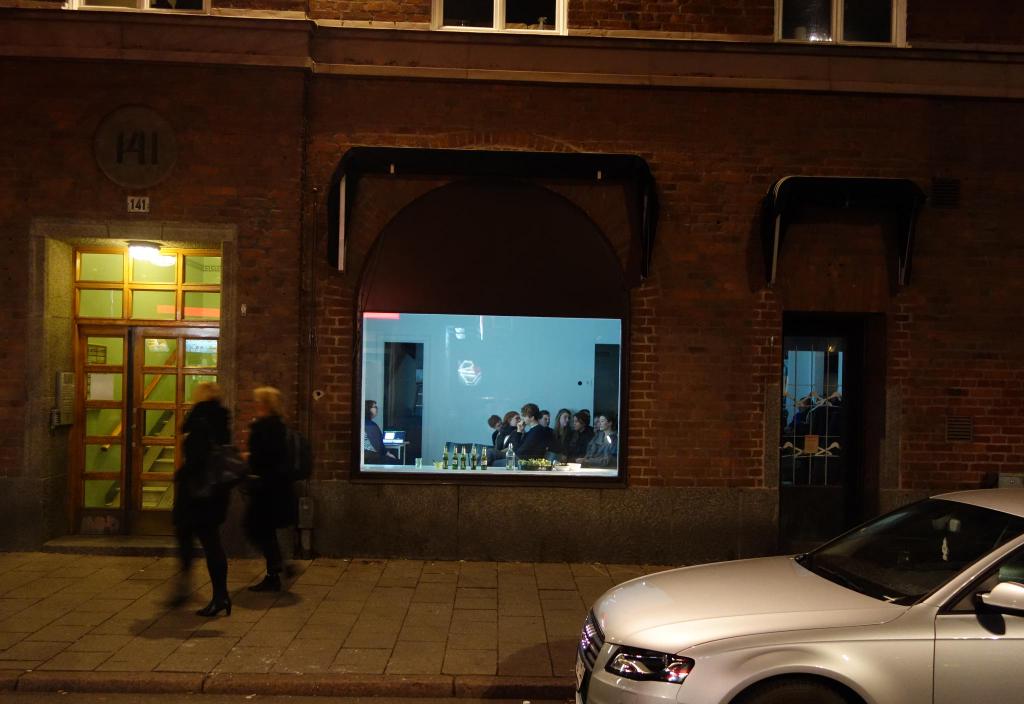
Arkitekturens Grannar returns to FFAR (Ringvägen 141) for a public event with architect and critic Mimi Zeiger. In the talk she will tract the rise of publishing as practice through her own work. Memos from the Front Line rejects the binary of the print and digital divide and suggests that the commingling of the analog and algorithmic creates rich territory for cultural production, collective criticism, and architectural experimentation.
On the day I arrive at Peter Shire’s Echo Park studio, a pile of fall fruit perches on a countertop. Bright orange persimmons and crimson pomegranates compete with the full spectrum of riotous color in the artist’s workshop. Racks are filled with multi-hued ceramics, and metal sculptures powder-coated in vivid green, blue, and violet hang from the ceiling. And then there’s Shire himself. He’s dressed in a tangerine t-shirt, a red apron, gray shorts, and lime and purple striped socks. Read More …

TEXTTEXT is a workshop at the Sandberg Instituut Studio for Immediate Spaces that explores the act of critical writing as drawn from keen observation and experience. The workshop takes the form of three parts over the course of two days: Reading, Ramble, and Reflection. Through the use of existing texts, constraint exercises, fieldwork, research, and digital tools, TEXTTEXT offers participants a framework for the production of a critical essay and a meditation on collective criticism.
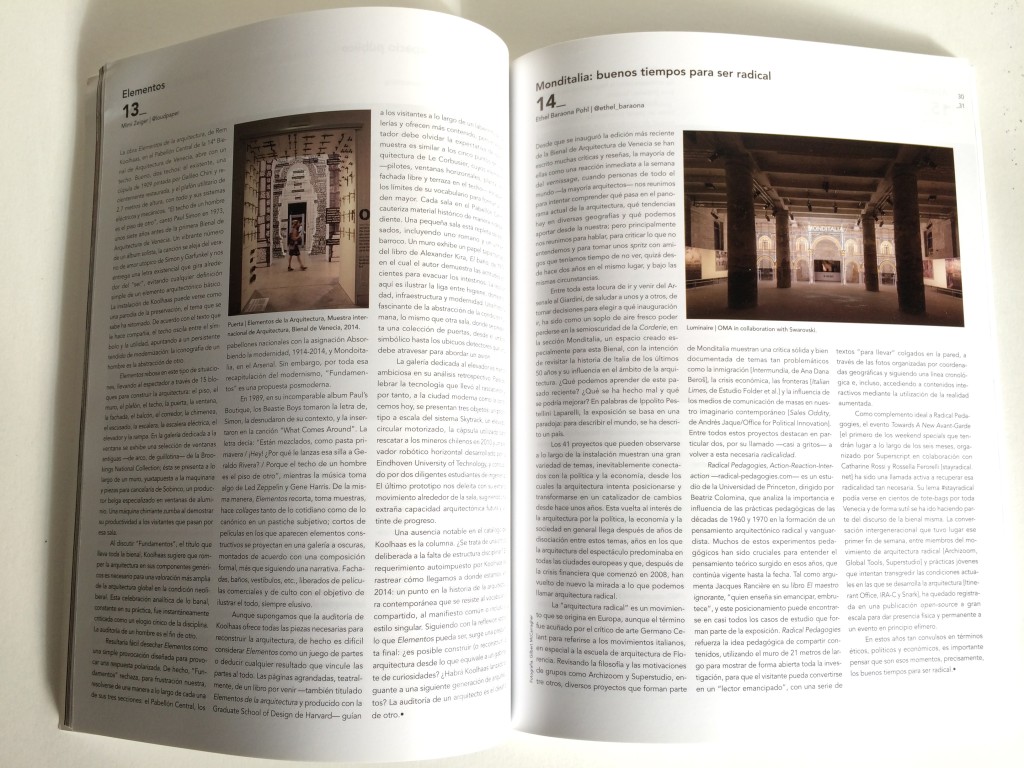
Rem Koolhaas’ Elements of Architecture in the Central Pavilion at the 14th Venice Architecture Biennale opens with a ceiling. Well, two ceilings: the existing, recently restored 1909 dome painted by Galileo Chini and a utilitarian drop ceiling hung at 2.7 meters, complete with electrical and mechanical systems. “One man’s ceiling is another man’s floor,” sang Paul Simon in 1973, some seven years before the first architecture biennale in Venice. A twangy number from a solo album, the song departs from Simon and Garfunkel’s summer of love utopianism and delivers an existential lyric that pivots on the “is,” eluding a single definition a basic architectural element. Koolhaas’ installation might seem like a parody of preservation, a subject he’s known for reconsidering. According to accompanying text, the ceiling is meant to oscillate between symbol and utility pointing out a lingering hang-up of modernization: one man’s iconography is another man’s abstraction. Read More …
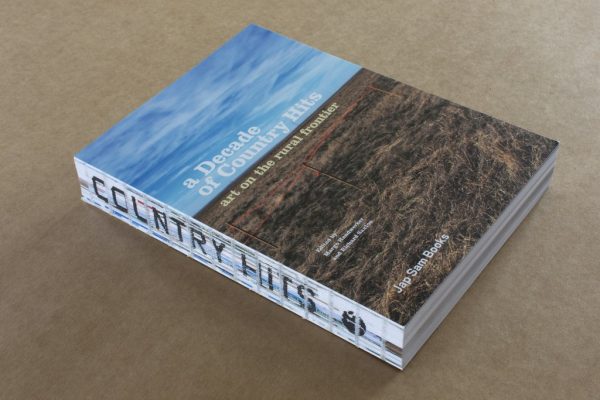
Edited by: Margo Handwerker and Richard Saxton. Featuring works by: Richard Saxton, municipalWORKSHOP, and M12 Collective. Graphic design: Peter de Kan Publisher: Jap Sam Books.
Art has its Billboard charts. They focus mostly on artists and exhibitions in urban centers. A Decade of Country Hitsis devoted to uncharted hits thriving instead on rural aesthetics and rural knowledge. This richly illustrated volume documents ten years of collective works initiated by artist Richard Saxton in rural communities around the world, from the American Midwest and Southwest to parts of Europe, Australia, and South America. Impossible to attribute to any one artistic genre, the works archived here explore a growing community of artists and researchers drawn to the rural experience in all its complexity. It resembles a sketchbook: with drawings, photographs, and from the hip accounts in the field, as well as contributions from likeminded artists, musicians, poets, and writers. Designed by Peter de Kan, the book is published by Jap Sam Books and distributed in North America and Canada by RAM Publications & Distribution.
A Decade of Country Hits includes an international roster of contributors. It contains interviews with Todd Bockley, co-director of the Center for Social Sculpture; Twink Metzler, founder of Living Room Studios; architectural historian Robert Nauman; and Wapke Feenstra, artist and co-founder of Myvillages. Featured throughout are new collaborations with Zach Boddicker, singer and songwriter for 4H Royalty; Kurt Wagner, singer and songwriter for Lambchop; and Matthew Fluharty, director of Art of the Rural. Providing context for the work are essays by artist Stuart Hyatt, founder of TEAM Records; as well as essays by critics and writers Josh Garrett-Davis, author of Ghost Dances: Proving Up on the Great Plains; Mimi Zeiger, author of New Museums: Contemporary Museum Architecture Around the World, Tiny Houses, and Micro Green; and Enrique Ramirez, whose writing has appeared in Perspecta, Thresholds, AA Files, and elsewhere. In addition are essays by award-winning artists Marjetica Potrč,Chris Sauter, and Fernando García-Dory, founder of A Shepherds School; as well as essays by curators, Ian Hunter, director of the LITTORAL Arts Trust; Marco Marcon, co-founder of International Art Space, and Kirsten Stoltz, programming director of the M12 Collective.
Los Angeles–based architect Barbara Bestor may have been dubbed queen of her neighborhood after publishing the book Bohemian Modern: Living in Silver Lake, but her love of art and culture goes beyond any zip code. A nonstop traveler, Bestor works what she’s seen—bright tile in Istanbul, mud mosques in Mali—into bold designs that are changing the face of L.A.
“Could life be more beautiful?” wrote Deborah Sussman on 1 November 1954 in a letter home to her parents. A young designer living in the Eames house and working for the office, she would become the environmental designer responsible for the iconic colourful graphics of the 1984 Los Angeles Olympics and countless bold visions, including the cartoonish lettering used on the billboard for the 1972 documentary Reyner Banham Loves Los Angeles.
Sussman passed away in August. Sharply present on the LA scene, even at 83, she had been quietly fighting breast cancer over the last year and news of her death was a sad shock to the design and architecture community. How could someone so vital be gone? Graphic designer April Greiman recalled a story of petite Sussman introducing herself by saying, “I’m kinda a big deal”. Read More …