If there’s a common question to be answered by the dozens of projects collected in Spontaneous Interventions, it might be: “What is the role of a local project in a global age?” The individual projects represented—pop-up parks, community agriculture, ad-hoc street furniture, guerrilla bike lanes—are not necessarily overt as they position themselves against the effects of global capital. However, taken as a group, these interventions run counter to the unchecked boom-and-bust development of what David Harvey and others critically describe as the neoliberal city. Small-scale and socially engaged, spontaneous interventions use design to enrich public space and foster civic life at a time when the disparity between daily life and the governmental and corporate mechanisms shaping cities is at an all-time high. Read More …
I heard Anthony Vidler lecture twice this past spring — once in Boston and once in Los Angeles. The subject matter varied as a much as the venue: the East Coast lecture a trip through Vidler’s own intellectual history and at SCI-Arc a jaunty tribute to Big Jim, made tart with a couple well-placed jabs at Shumacheresque parametricism. Yet, in both of Vidler’s lectures the same slide appeared, Richard Hamilton’s collage Just What Is It That Makes Today’s Homes So Different, So Appealing? that appeared as the poster for the Independent Group’s This is Tomorrow exhibition in 1956.
Vidler outted the collage fragment depicting Earth that looms above at the top of the composition, noting that it was torn from a 1955 issue of Life. As this view of the world entered into mainstream public consciousness via the most popular magazine on the planet it carried with it the tension between rampant consumerism and the Cold War. Entitled a 100 Mile Portrait of Earth, the composite photograph was made from stills taken by an aerial movie camera attached to a rocket. At the time, no other color photo had ever been taken from such a high vantage point.
This popularization and implied democratization of a once-privileged view mixes with a Cold War chill in the exhibition Ends of the Earth: Land Art to 1974 at MOCA’s The Geffen Contemporary in Los Angeles. This broad, historical retrospective brings together a generation of artists working under threat of nuclear annihilation, the space race, who possessed an expansionist drive to push outside of the gallery and into the unknowns of landscape. Read More …
In 1909, the french banker Albert Kahn began his Archives of the Planet, a project as ambitious as its title suggests. During the next 22 years—and spanning a world war—Kahn sent a fleet of photographers to more than 50 countries around the globe to create a visual record. Today, the archive is housed at the Musée Albert-Kahn, located in the financier’s former garden estate in suburban Boulogne-Billancourt, just west of Paris. His collection of 72,000 perfectly preserved color autochromes documents a world on the verge of the modern era. Snippets of history we’ve grown accustomed to seeing in sepia tones are pictured in vivid color. These are snapshots of another time, but bright hues in most images render the subjects—including World War I soldiers and Vietnamese performers—immediate and full of life.
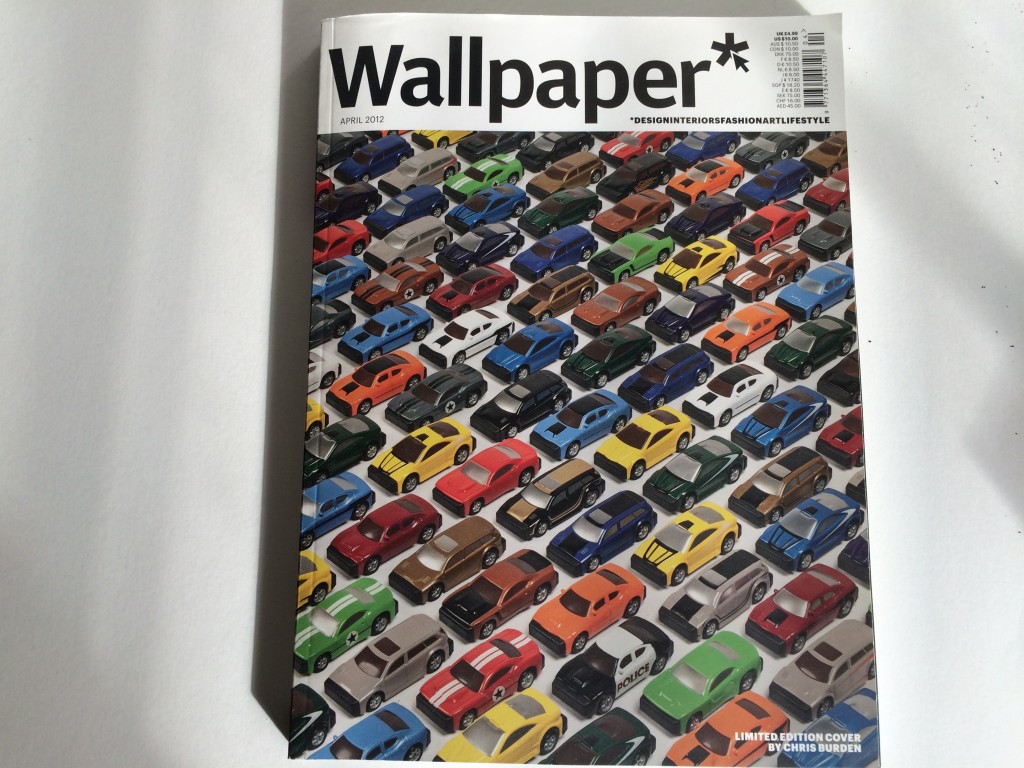
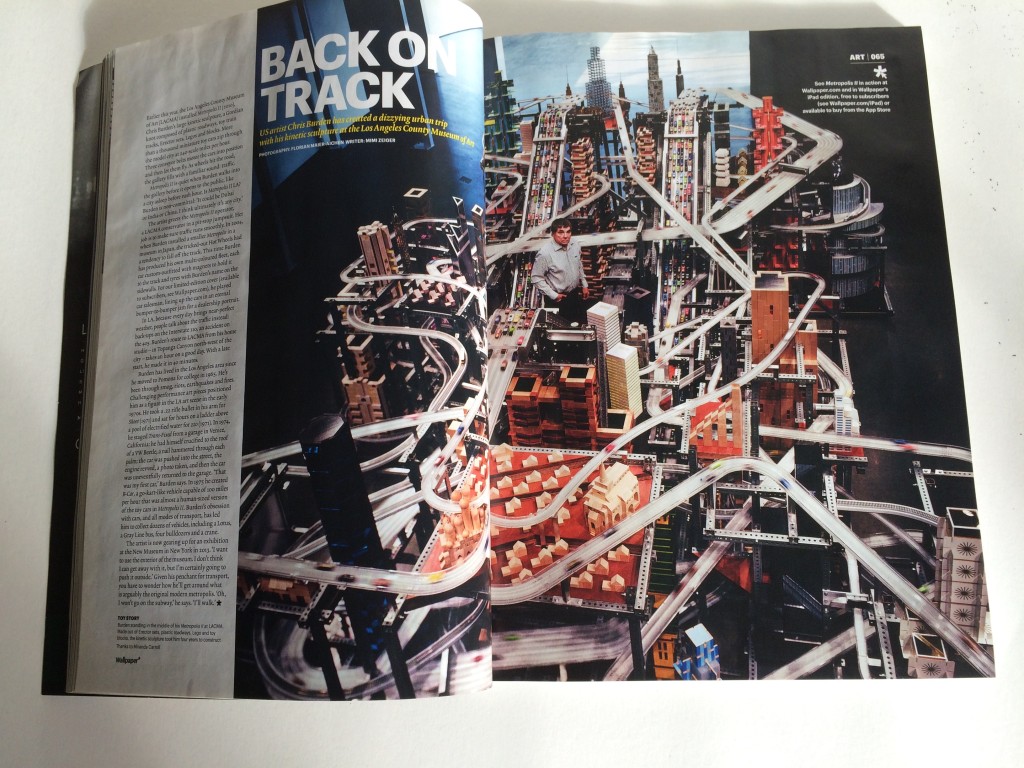
Earlier this year, the Los Angeles County Museum of Art (LACMA) installed Metropolis II (2010), Chris Burden’s large kinetic sculpture—it’s a Gordian knot composed of a plastic roadways, toy train tracks, Erector sets, Legos, and blocks. More than a thousand miniature toy cars zip through this model city at 240-scale miles per hour. Three conveyor belts motor the cars into position and then let them fly. As wheels hit the road, the gallery fills with a familiar sound: traffic.
Metropolis II is quiet when Burden walks into the gallery before the museum opens to the public, as if the city is asleep before rush hour. Is Metropolis II Los Angeles? Burden’s non-committal—he shrugs as if he’s heard this one before. It’s one city or all cites. “It could be Dubai or India or China,” he explains. “I think ultimately it’s any city.”
The artist, with salt and pepper mop-top and sporting striped oxford, greets the Metropolis II operator, a LACMA conservator in a navy blue pit-stop jumpsuit. Her job is to stand inside the urban contraption and make sure there are no pile-ups or cars careening off the tracks. In 2004, when Burden installed a smaller Metropolis in a Japanese museum, the tricked-out Hot Wheels had a tendency to fall off the track. For Metropolis II, Burden produced his own multi-colored fleet (including black and white cop cars). Each custom outfitted with magnets to hold them to the track and tires detailed with Burden’s named spelled out on the side walls. For this month’s cover Burden played car salesman and lined up the vehicles for a dealership portrait. All the little cars are motionless, caught in an eternal bumper-to-bumper jam.
In Los Angeles, because every day brings near-perfect weather, people talk about traffic: back-ups on the I-110, an accident on the 405. Today, January brings more blue sky. Burden’s route from his home studio—located on an expanse of land in Topanga Canyon northwest of the city—takes an hour on a good day. Today was a good day. He drove his wife’s BMW station wagon. With a late start, he made it 40 minutes. A critique often levied at Metropolis II is that Burden’s vision of the city is too car-dependent, too unrealistically seeped in oil, and generally unsustainable. He counters that in the future all cars will be run by satellites and GPS control. “It would all be timed perfectly and you wouldn’t have to slow down at any lights,” he explains. “There wouldn’t be red lights or green lights. You just move right through… like fish.”
Burden’s lived in the Los Angeles area since he moved to Pomona for college in 1965. He’s been through smog, riots, earthquakes, and fires. Challenging performance art pieces that bordered on the edge of disaster positioned Burden as a figure in the Los Angeles art scene in the early 1970s. He took a .22 rifle bullet in his arm for Shoot (1971) and sat for hours on a ladder above a pool of electrified water, 220 (1971). In 1974, he staged another piece of extreme art in a Venice, CA garage. For Trans-Fixed, Burden had himself crucified to the roof of a VW Beetle, complete with a nail hammered through each palm. The car was then pushed into the street, the engine was revved, and then after a photograph was taken, the car was uneventfully returned to the garage.
In the mid-Seventies, Artforum ran one of the first cover stories on Burden. In the piece critic Robert Horvitz wrote of Trans-Fixed, “Replacing the cross with a Volkswagen effectively transformed a religious cliché into a diabolically droll, nightmarish masque: Jesus, indeed.” Nearly four decades later, the relationship between his physical, edgy artworks and the crowd-pleasing, child-friendly Metropolis II seems tenuous. Yet for the artist, the connection is there.
“That was my first car,” Burden says of his Trans-Fixed co-star.
“I owned a lot of Volkswagens and Beetles. They were really good cars when you were in college because you could buy them for $200 or $300 and then sell them for the same amount. They were freebees. I must have had five or six Beetles before I bought my first truck. I was making big sculptures at the time and I was trying to schlep materials around in my Volkswagen. I remember having two inch pipes sticking out though the window frame and the doors getting kind of screwed up.”
In 1975, he created the B-Car, a streamlined, go-cart–like vehicle equipped with four bicycle wheels and ready to propel its driver 100 miles per hour down the road—almost a human-sized version of the toy cars zipping around Metropolis II. Burden’s obsession with cars, and really all modes of transportation, led him to collect dozens of vehicles on his property in Topanga. He has four bulldozers, a Greyline bus, a forklift, an electric crane, a Lotus, two 4x4s, a Mazda RXA, and three Citroën Deux Chevaux trucks. (The last were for an unrealized French project entitled Mini Video Circus. Burden imagined that the little trucks would be equipped with video decks and monitors and then parked like a mini movie theater in a French village. Villagers would pay a franc to watch footage of earthquakes, fires, and riots, or as Burden puts it “unrelenting disaster in Los Angeles.”)
With the success of Metropolis II, Burden is gearing up for a 2013 exhibition at the New Museum in New York City. He’s scheming: “I want to use the exterior of the museum.
I don’t think I can get away with it but I’m certainly going to push [the exhibition] to the outside.” Burden even has plans to top the museum with the two mini skyscrapers he designed in 2003.
Given his penchant for transport, you have wonder how the artist will get around what is arguably the original modern metropolis. “Oh, I won’t go on the subway,” says Burden. “I’ll walk.”
his past December, just as retailers were making their holiday markdowns and non-profits issuing their year-end appeals, the Storefront for Art and Architecture was opening its last exhibition of 2011. Spurred by Occupy Wall Street, Strategies for Public Occupation featured “projects and strategies that offer a new, creative and productive way of spatial occupation for public demonstrations and actions in cities throughout the world.” In parallel Storefront hosted a week of workshops, performances and lectures in which artists and architects presented their own interpretations of the Occupy movement. Strategies for Public Occupation was, in short, intended to be a summation of interventionist practices and a wide-ranging discussion about the relationships among citizens, cultural producers and public space.
Unfortunately, Storefront got the title wrong.
It’s time to put a moratorium on urban agriculture. On guerrilla street furniture. On food trucks and on yarn bombing. As a DIY enthusiast and a known proponent of tactical urbanism, I say this with a heavy heart. Read More …
On the last night in December, on the last day of the 2011, the Merce Cunningham Dance Company performed for the last time. The avant-garde choreographer passed away in 2009 and the Park Avenue Armory Events, as the piece was called, was an immersive celebration of his legacy, embodying Cunningham’s experiments in chance procedures and collaborative work. (He famously partnered with John Cage nearly 50 years, who, according to company lore, was not only the music advisor, but in the early years, the bus driver.) Read More …
In late November, Barcelona-based Portuguese artist Carlos Bunga took over the lobby of the Hammer Museum in Los Angeles, installing an architecturally scaled artwork made out of his signature materials: cardboard, packing tape and paint. The site-specific sculpture, which fills two walls adjacent to the museum’s semi-monumental staircase, is enigmatically entitled Landscape (2011) and is part of Hammer Projects: Carlos Bunga, a show that includes not only the installation but also a selection of Bunga’s drawings, paintings, sculptures, and videos dating from 2002 to 2008. The title conforms to a naming conceit reserved for visual artists and poets. Everyday vocabulary is held up for more specific inquiry. Language vagaries are turned over and over for multiple readings. Read More …
Based, in Bologna, Italy, Blu creates politically charged murals, borrowing visual inspiration from the Surrealists. Using house paint and rollers to draw human figures, Blu often comments on the exploitation of natural resources. Graffiti artists have long used video to document their ephemeral work, but Blu’s videos thoroughly reinvent the practice. In his digital stop-motion films, he animates his figures frame by frame, and the drawings appear to come to life as Blu paints out each old image and creates a new one.
Swoon’s artwork stand out in a street art world that’s oft populated with brash, pop art figures. Where some of her guerrilla colleagues fill walls with Andre the Giants, cartoon characters, and Andy Warhol wannabes, she creates life-sized paper cut outs of everyday people, realistic rendered in black and white. With her bike nearly for a quick getaway, she wheat pastes these enigmatic souls—women, children, mermaids—at eye level where they interact with people who happen by. Born in Daytona Beach, Florida and trained in fine-arts at Brooklyn’s Pratt Institute, Swoon’s illustrations and hand-cut paperwork draw on formal and folk traditions—German Expressionist and Japanese wood block printmaking, Mexican papel picado, and Wayang Kulit, the shadow puppets from Central Java. Read More …