Mimi Zeiger

Critic, editor, curator and instigator.

The architect never studied with the masters, but his work was a radical reaction to the Colorado environment, and an expression of futuristic ideals.

Joel Haertling, son and de facto archivist of the late architect Charles A. Haertling, faxed over a single page written by his father. Titled “Thoughts on Architecture,” it’s a blurry, typewritten list. Charles Haertling succumbed to a brain tumor in 1984, but the text is immediate and cuts across the years: 21 enumerated glimpses into a creative mind. Someone has circled point number 14: “Design is always a tortuous, grueling, almost maddening, though heavenly sweet, task.” The line is as familiar as it is revealing. Look at Haertling’s houses with their radically pitched roofs, daring cantilevers, and mushrooming facades—products of a career spent building in the Boulder, Colorado, area—and you can see both his pleasure and his pain.
Read More …

“I was never an architect’s architect. I’m too impatient. I just can’t wait around for years for a building to get built,” says New Orleans sculptor Laurel Porcari. Her preferred medium, kiln-formed glass, is hot, heavy, and dirty, but immediate—a far cry from CAD drawings. Nevertheless, her pieces, cast so that the material flows and warps to take on textures or resemble landscapes, capture an architect’s sensibility. After receiving her Master of Science in architecture. from Columbia in 1993, Porcari headed for Australia, where she taught design in both Perth and Melbourne. She was also working in plastic, hand-printing abstract maps on acrylic sheets to create art installations. Returning to the States, she landed in New Orleans to study in the urban design Ph.D. program at Tulane University.*

Read More …

“I was never an architect’s architect. I’m too impatient. I just can’t wait around for years for a building to get built,” says New Orleans sculptor Laurel Porcari. Her preferred medium, kiln-formed glass, is hot, heavy, and dirty, but immediate—a far cry from CAD drawings. Nevertheless, her pieces, cast so that the material flows and warps to take on textures or resemble landscapes, capture an architect’s sensibility. After receiving her Master of Science in architecture. from Columbia in 1993, Porcari headed for Australia, where she taught design in both Perth and Melbourne. She was also working in plastic, hand-printing abstract maps on acrylic sheets to create art installations. Returning to the States, she landed in New Orleans to study in the urban design Ph.D. program at Tulane University.*

Read More …

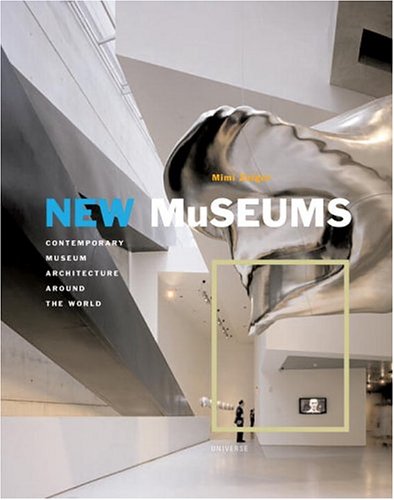
Since the opening in 1997 of the Guggenheim Bilbao, designed by Frank Gehry, museum architecture has enjoyed worldwide attention on an unprecedented scale. That single watershed project demonstrated to municipalities that architecture has the power to transform the image of an entire city, thus making the turn of the twenty-first century the unofficial age of the museum building.

New Museums examines the boom in high-design museum projects in detail, beginning with the Guggenheim Bilbao’s groundbreaking role in the development of contemporary museum architecture. It continues with a beautifully illustrated tour of 30 examples of the most innovative and exciting museum architecture around the world, including Tadao Ando’s Museum of Modern Art in Fort Worth, Zaha Hadid’s Contemporary Arts Center in Cincinnati, Renzo Piano’s Nasher Sculpture Center in Dallas, and many others.

San Francisco’s Mission District—like many low-income neighborhoods in high-rent cities—is a mix of immigrants, primarily Latin American, and hipsters. Gentrification spread rapidly through the area in the late 1990s, during San Francisco’s dot-com boom, but has slowed postbust. On the trendier blocks, taquerias sit alongside sushi-cum-oxygen bars. Live/work lofts and boutique retail spaces serving the better-heeled residents are commonplace. But new construction that addresses both ends of the economic spectrum is rare. Read More …

Pibs. You know who they are and you know who you are. People in Black, or Pibs, as Gail Andersen of Lofts Unlimited calls them. They wear funny glasses and cool shoes, drink double espressos and live in lofts. In the early ’90s, when Andersen and her partner, Ray Kaliski, sold their first lofts in San Francisco, it was the Pibs who were their clientele. Who but the noble, artistic sort would find a safe haven in the bare bones chic of unfinished concrete and soaring ceilings? But as Starbucks brings the urban coffeehouse to Middle America, the loft, the domestic equivalent of the latte, is appealing to a range of people who may even wear floral print. The current real estate market finds the demand for lofts to be steadily increasing, booming, even. No longer confined to New York or San Francisco, loft sales are even brisk in Denver, Miami, and Atlanta. Read More …