Mimi Zeiger

Critic, editor, curator and instigator.

AGENCY has been selected to exhibit at the Venice Biennale (La Biennale di Venezia), acting as ambassadors for SUPERFRONT in collaboration with At Work With at the Nordic Pavilion to realize “30S”, a crowdsourced video installation addressing the role of the architect in the design of public space.

Project Description
The project expands the theme of the 12th International Architectural Exhibition at the Venice Biennale to highlight the role of the festival itself in fabricating and amplifying the identity of the contemporary architect.

While “people meet in architecture”, the architect often operates in environments uncannily devoid of interpersonal contact. Paradoxically, it is from these most private spaces that our cities’ civic buildings and public spaces are designed.

The installation will linger in the private space of the architect, projecting a continuous stream of user-generated content from an installation-specific web-based video channel, acting as a clearinghouse for 30-second clips of static-shot digital video. Video will highlight the quotidian, intimate, and banal aspects of architectural endeavor, forcibly colluding these highly personal spaces with the public realm by means of digital projection into the exhibit space of the Pavilion.

AGENCY will host user-generated content in a continuous, looping stream on the AGENCY blog.
“In old days books were written by men of letters and read by the public. Now books are written by the public and read by nobody.”—Oscar Wilde

The popularity of the aphorism, a short, memorable, often pithy statement, goes hand in hand with the invention of printing. Throughout the 18th, 19th, and 20th centuries, aphorisms and maxims were published globally in thick, bound collections. Although print remains precarious in a digital age, the aphoristic statement lives on.

For the Book Launch Cabaret at Storefront for Art and Architecture to celebrate Studio-X’s release, The Studio-X NY Guide to Liberating New Forms of Conversation (GSAPP Books, 2010), edited by Gavin Browning, Mimi Zeiger presented Maximum Maxim MMX a zine maximized with maxims germane to architecture and publishing.

Traveling the world as part of Archizines.

Eight-foot tall man in a perfect Malcolm X suit selling whole leopard skins and persimmons oil and cobra venom incense and a table of books by some conspiracy wrangler named Napoleon Fung gets hungry for a Jamaican meat patty wrapped in coco bread. Wrap that in a slice of pizza and cough out a chicken bone you didn’t even know was in there. Drumstick bones in an accumulating heap teeter down the subway portal. The city bus skids off Butt Flash onto Full-Time, doomed pedestrians swept up by its Soylent Green people-catcher depositing them in a jumble on the Albeit Squalor Mall escalators — going up!

— Jonathan Lethem, “Ruckus Flatbush” from Brooklyn Was Mine

The Fulton Mall in Downtown Brooklyn is a jumble of every hope and dream ever projected on the borough. Implicated in every era and every development, from the opening of the Brooklyn Bridge in the 1880s to the boosterism of the postwar years, from the urban renewal and brownstone gentrification of the ’60s and ’70s to the Bloomberg-era building bubble, the eight-block-long shopping street routinely fails to live up to expectations. The gulf between the reality of the mall — today a thriving mix of retail tenants paying high rents and selling cheap goods to a diverse crowd of low- to middle-income shoppers — and the ever-frustrated vision dreamed over and over by civic leaders, businessmen and planners — that it would become a visually unified, sanitized and safe environment attractive to both high-end national chains and an equally well-heeled clientele — is the subject of Street Value: Shopping, Planning and Politics at Fulton Mall [Princeton Architectural Press, 2010]. Read More …

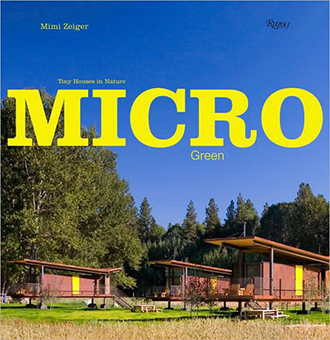
From treehouses to pre-fabs, this book presents sustainable, micro-green living at its best. Micro Green delves into the concept of compact living and demonstrates the possibilities of living with less while maintaining a rich life. As sustainable architecture becomes mainstream, many architects and designers are using technology and wit to experiment with what it means to be green, and the results are both effective and enthralling. The rustic treehouses, airy domes, and recycled-scrap structures of Micro Green are presented through vivid photography and detailed building plans, and display a range of environmental influences. Here living spaces are carved out of hillsides, trees rise through decks and floors, and walls melt seamlessly back into the surrounding woods. Though many of the homes chronicled in Micro Green are unique in design, their economical size and ingenious interior spaces are the epitome of practicality and illustrate an acute understanding of compact living and its potential for rural, suburban, and even urban ecosystems. Small in both carbon and architectural footprint, the dwellings in Micro Green have large implications for the global movements of eco-consciousness and sustainability.

In Chronic City, Jonathan Lethem’s 467-page, pot-fumed meditation on New York City’s Upper East Side, the author describes a fictional artwork by a fictional artist: Urban Fjord by Laird Noteless, a figure cut out of the same cloth as land artist Michael Heizer. A monumental earthwork, the piece taunts viewers into throwing all types of detritus into its gaping mouth. Curiously, New York’s Guggenheim Museum holds a similar sway. Frank Lloyd Wright’s iconic design – the tantalising volume bounded by spiralling ramps – begs to be filled, but with what? Trees? Trampolines? Chocolate? Read More …

Rising Currents: Projects for New York’s Waterfront, the latest exhibition to open in the architecture and design gallery of the Museum of Modern Art, begins with a grim premise: that global climate change is making sea levels rise and powerful storm surges more frequent. Watch out, we’re gonna get wet. If we don’t take action, we’re in for catastrophe, with floods wiping out parts of Lower Manhattan, Brooklyn and northern New Jersey. To underscore the creek we are up, the exhibition designers have grafted water lines — two, four, six, eight, ten feet — on the dark gray gallery walls. Glub, glub. Read More …

“Well, ‘what happens in Vegas … ’?” began a Yale University professor, Emmanuel Petit, about halfway through the first day of the “Architecture After Las Vegas” symposium held at the New Haven institution in January. It was just a matter of time before someone invoked Sin City’s marketing slogan—such low-hanging fruit at a highbrow conference. The crowd that filled the auditorium of Paul Rudolph Hall—academics, architects, and students—tittered at the pop-culture quip. Read More …

“Well, ‘what happens in Vegas … ’?” began a Yale University professor, Emmanuel Petit, about halfway through the first day of the “Architecture After Las Vegas” symposium held at the New Haven institution in January. It was just a matter of time before someone invoked Sin City’s marketing slogan—such low-hanging fruit at a highbrow conference. The crowd that filled the auditorium of Paul Rudolph Hall—academics, architects, and students—tittered at the pop-culture quip.

Read More …

Kicking aside the Kone Dirt Devil flotsam, I pluck a plastic bottle from the oily surf. To cross the Palm by sunrise, I’ll need resources: water, anti-bacteria wipes, and ammo. The Avant Garde control the easternmost fronds and the Urban Gardeners’ Free Ranger Chickens patrol the west. In this archetypal battle—abstraction versus nature—my comrades and I fight for beauty.

This decade is our chance. At dawn, Burj Skeleton broadcasts the revolution. Its remaining infrastructure will vibrate with our adhan. Chengdu, listen.

The GeoEye satellite crests the horizon. It’s nearly time. My balaclava itches. Bottle tucked in my waistband, I run.

Spoiler alert! The Japanese maple in Jeff Dauber’s San Francisco backyard is not at the center of a carbon-sucking vortex. Sorry, sci-fi fans, but the Berkeley-based architect Thom Faulders’s perfectly flat deck only looks like its far corner has its own warped gravity. Ever since Francesco Borromini’s Gallery Spada, in Rome, forced perspectives and architectural patronage have gone hand in hand, but whereas the Renaissance architect employed a mathematician to make that arcade seem longer through foreshortening, Faulders used 3-D–modeling software to achieve Deformscape’s dipping effect. Read More …