Mimi Zeiger

Critic, editor, curator and instigator.

Big City Forum returns for a second annual residency at Armory Center for the Arts with a new series, entitled Transforming the Social, which features six panel conversations that recognize and celebrate the ability to create transformative moments within the scope of the built environment and social space. Armory is pleased to have been hosting Big City Forum in residence since 2012, which saw the launch of Mapping LA, a series of four events exploring current creative practices that inform the landscape and geography of Los Angeles. Through its residency at Armory, Big City Forum is deepening its ongoing investigation of social and civic space within the built environment of the Los Angeles region. The residency builds upon a shared interest between the Armory and Big City Forum in advancing public discourse on the notion of social and civic engagement.

This panel discussion brings together four practitioners from the fields of art and architecture to discuss the complexity of social engagement. Speakers will investigate the agency of art and design when shaping spaces for a public. What I Talk About When I Talk About Community asks for more refined understanding of community, in order to reveal the politics, pitfalls, and pleasures of these practices.

Featuring:
Victor Jones, principal of Los Angeles-based Fievre Jones, cultural activist, and writer, whose research lies at the intersection of architecture, urban design, and community building within cities. Recent design projects include the Platform for Watts House Project (2011) and a skate park for New Orleans’ City Park (2009). His design work has been supported by numerous grants, including the Graham Foundation, Artplaces, and the Nathan Cummings Foundation. He is currently Assistant Professor of Architecture at the University of Southern California.

ennifer Su and Laura Noguera, co-owners of Thank You for Coming, a communal restaurant/residency program that “aims to give people with varying experiences and backgrounds an opportunity to explore and execute ideas around sharing food. Residents are invited to utilize our restaurant space as a platform for public engagement and creative experimentation.

James Michael Tate received his Masters of Architecture from Yale University and Bachelors of Environmental Design from Texas A&M University. He has previously worked for MOS, Peter Eisenman, and Samuel Mockbee. Tate co-taught a studio with Michael Maltzan at Rice University this past spring; the experience motivated him to move to Los Angeles. Tate designs, makes, writes, and participates in a variety of architectural affairs. His current affinities include narratives, oppositional dialectic blends, seeking refuge in unsettled territories between art and architecture, the latent potentialities of history in contemporary experiments, and the Korean taco food-truck.

Moderator:
Mimi Zeiger, editor and publisher of loud paper, a zine and blog dedicated to increasing the volume of architectural discourse. As writer and critic she covers art, architecture, urbanism, and design for the New York Times, Domus, Dwell, and Architect, where she is a contributing editor. Zeiger is author of New Museums: Contemporary Museum Architecture Around the World; Tiny Houses; and Micro Green: Tiny Houses in Nature.
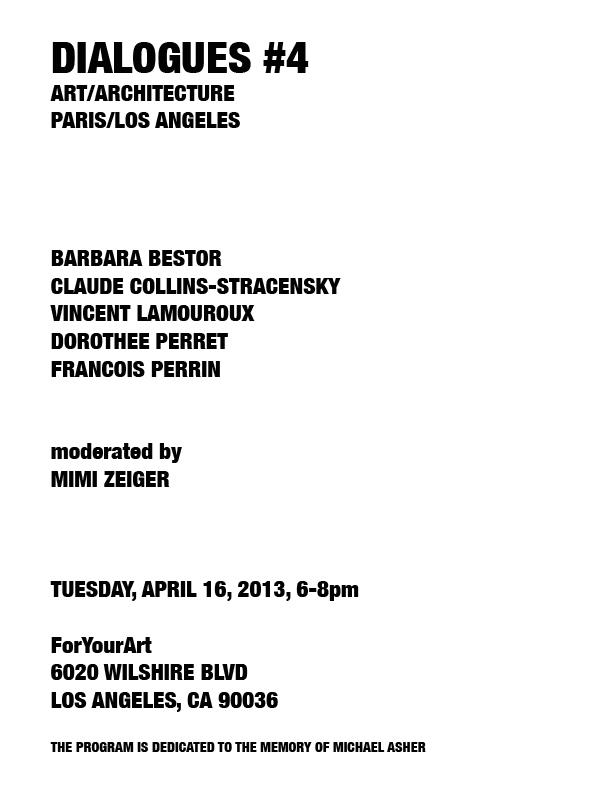
JOIN US FOR THE FINAL DISCUSSION OF DIALOGUES
AND THE CLOSING OF THE EXHIBITION

HTTP://WWW.DIALOGUESPROJECT.ORG/

DIALOGUES #4
ART/ARCHITECTURE
PARIS/LOS ANGELES

BARBARA BESTOR
CLAUDE COLLINS-STRACENSKY
VINCENT LAMOUROUX
DOROTHEE PERRET
FRANCOIS PERRIN

moderated by
MIMI ZEIGER

TUESDAY, APRIL 16, 2013, 6-8pm

ForYourArt
6020 WILSHIRE BLVD
LOS ANGELES, CA 90036

THE PROGRAM IS DEDICATED TO THE MEMORY OF MICHAEL ASHER

To mark the launch of the exhibition Archizines in Los Angeles, a discussion moderated by Sylvia Lavin, UCLA architecture and urban design professor and director of critical studies and M.A./Ph.D programs, will bring together architecture, art and design publishers to explore the different approaches to subversive visual culture and how this relates to architectural criticism.

Panelists include:
Elias Redstone, curator of “ARCHIZINES”
Susan Morgan, editor of “Art Papers on Design and Architecture” magazine
Thomas Lawson, dean of the School of Art at the California Institute of the Arts and editor of the online art magazine East of Borneo
Jonah Rowen, founding editor of Project
John Southern, founding principal of Urban Operations
Leonard Koren, editor of Wet magazine
Mimi Zeiger, journalist and critic

Exhibition Opening: 8 – 9 pm
Perloff Gallery, Perloff Hall
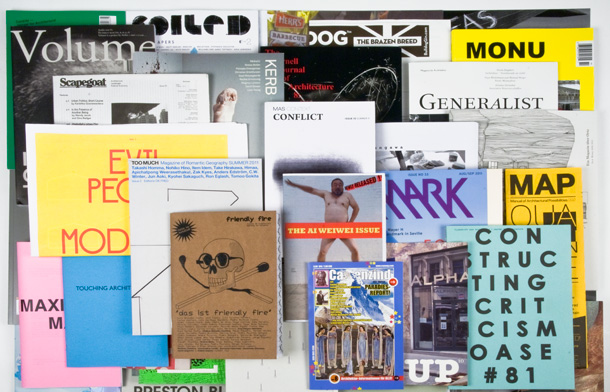
UCLA A.UD is delighted to host the critically acclaimed international exhibition ARCHIZINES in the Perloff Gallery, the 18th stop on the world tour that has taken in cities from Tokyo and Osaka to New York, London, Paris, and Berlin.

ARCHIZINES celebrates the resurgence of alternative and independent architectural publishing around the world. The touring exhibition, curated by Elias Redstone and initiated in collaboration with the Architectural Association, now features 90 architecture magazines, fanzines and journals from over twenty countries that provide an alternative to the established architectural press. Edited by architects, artists and students, these publications provide new platforms for commentary, criticism and research into the spaces we inhabit and the practice of architecture.

The publications, all launched after 2005, vary in their style and approach to editing architecture. However, together they make an important and often radical addition to architectural discourse and demonstrate a residual love for print matter in the digital age. Each publication has selected one issue to be presented in the exhibition. These are all available to read alongside video interviews with their creators, revealing the people behind the publications and the shifting relationship between architecture and publishing today.

The ARCHIZINES collection continues to grow as more publications are discovered, and the full collection is being transferred to the National Art Library at the Victoria & Albert Museum, London.

If you’ve ever looked at an aerial view of Los Angeles via Google Maps or on decent into LAX then you know: L.A. is a city of houses. Precarious mansions climb up the hills and fill in the canyons. Detached single-family homes sit side-by-side on modest lots across the basin. “Miles and miles of little houses, wooden or stucco, under a Technicolor sky,” wrote Christopher Isherwood in his diary in May 1939, aghast. British expat viewed L.A. as ugly and unreal when compared to East Coast and European cities — New York, London, Berlin — are dense with skyscrapers, office towers, apartment buildings, and tenements. But the reality is that this condition makes the city rich with possibilities for how to live.

“The house was and continues to be the most predominant building type in the city. It was just the sheer numbers that made it so the experiment could happen,” explains architect Michael Maltzan on the phone from his Silver Lake office. Read More …

You can find Design, Bitches’ office on a pre-war residential street in Los Angeles’ Atwater Village. Out front: two motorcycles and a succulent garden. In the rear: a shed-like studio and three chickens. Founded by Catherine Johnson and Rebecca Rudolph, their workspace is just a few blocks from the Beastie Boys’ former headquarters where, until recently, a small shrine adorned with a bouquet of mums placed in front of a State Farm Insurance paid tribute to MCA (Adam Yauch). Understanding where Design, Bitches is located in LA’s urban fabric, that high-low mash-up of typologies, ethnicities, and palm trees, goes a long way to understanding where Design, Bitches is located philosophically. You’ll find them at the corner of architecture culture and pop, throwing a little attitude towards disciplinarians who like to keep the edges of architecture nice and neat.

Read More …

Film Appearance

TINY is a documentary about home, and how we find it.

The film follows one couple’s attempt to build a “tiny house” from scratch, and profiles other families who have downsized their lives into homes smaller than the average parking space.

Through homes stripped down to their essentials, the film raises questions about good design, the nature of home, and the changing American Dream. Read More …

t a time when the words “big box” are spat out as insult of overconsumption, Zellnerplus’s recent project, the Matthew Marks Gallery in West Hollywood, is a windowless medium-sized. Architect Peter Zellner designed a 3,000 square foot study in restraint. A single (albeit elongated) glass door opens onto two white-walled galleries lit by a deceivingly simple grid of skylights, six rectangular apertures centered in the larger space. The venue opened its West Coast outpost in late January with the exhibition Ellsworth Kelly: Los Angeles, a collection of the 88-year old artist’s spare geometries. Read More …

For the launch of the publication of InfraNet Lab/Lateral Office’s Pamphlet Architecture 30+, Coupling: Infrastructural Opportunism, Storefront staged Manifesto Series 02: Infrastructural Opportunism.

Many thanks to Mason, Lola, and Eva for inviting me to participate.

The awesome infrastructural lineup was:
MIMI ZEIGER on manifestos
INTERBORO on exclusion
DIANA BALMORI on realignments
JASON VIGNERI-BEANE on stripping down
LYDIA KALLIPOLITI on remedies
ANDREW BLUM on tubes
JOYCE HWANG on interventions
MAMMOTH on expanding fields Read More …

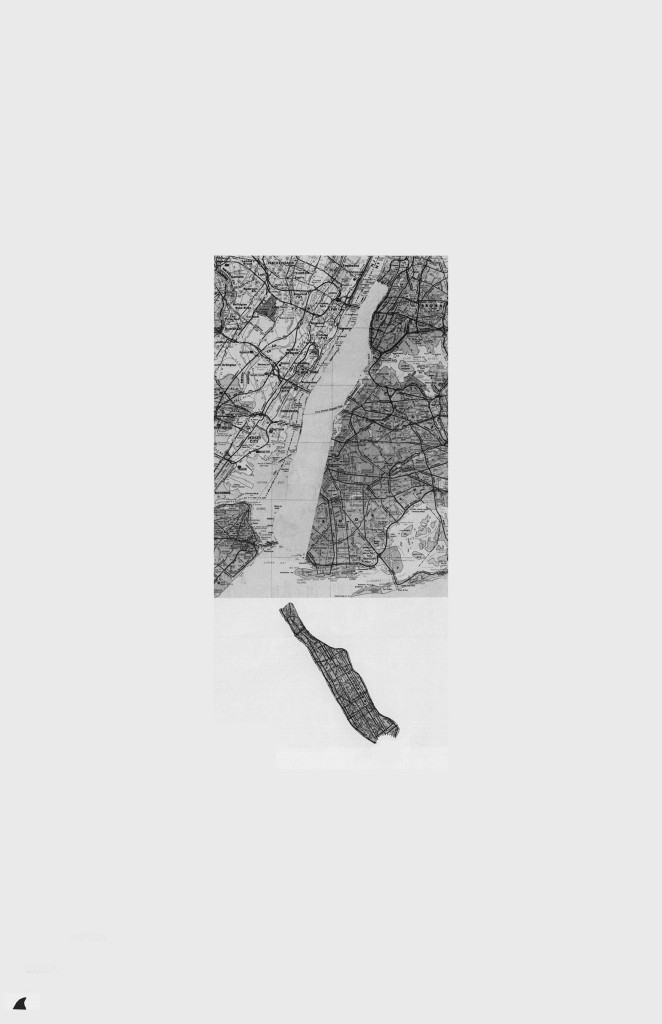
OVER BLACK

Sounds of the inner spaces rushing forward.

Then a splinter of blue light in the center of the picture.
It breaks wide, showing the top and bottom a silhouetted curtain of razor sharp teeth suggesting that we are inside of a tremendous gullet, looking out at the onrushing under-sea world at night. HEAR a symphony of underwater sounds:
landslide, metabolic sounds, the rare and secret noises that certain undersea species share with each other. Read More …

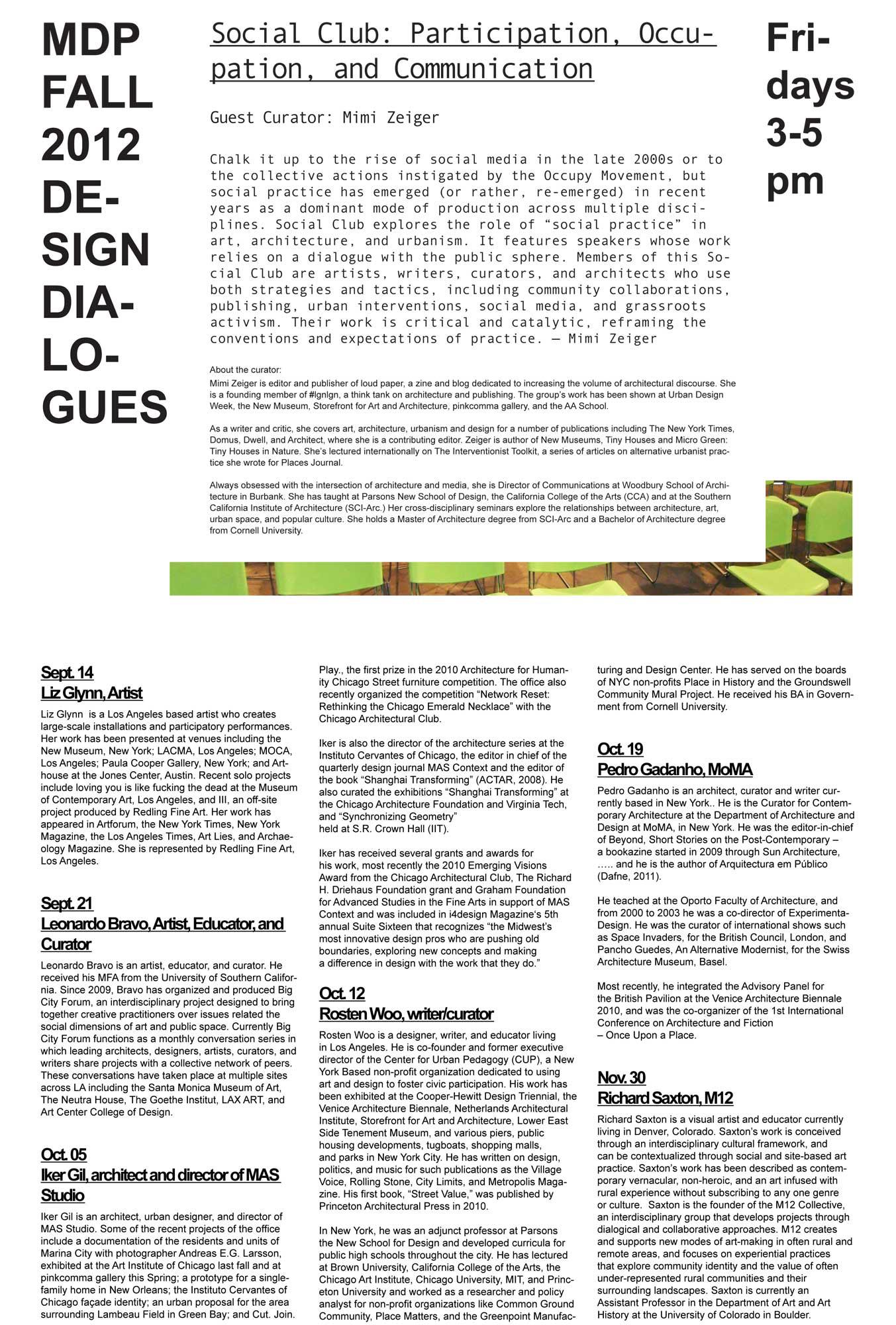
Chalk it up to the rise of social media in the late 2000s or to the collective actions instigated by the Occupy Movement, but social practice has emerged (or rather, re-emerged) in recent years as a dominant mode of production across multiple disciplines. Social Club explores the role of “social practice” in art, architecture, and urbanism. It features speakers whose work relies on a dialogue with the public sphere. Members of this Social Club are artists, writers, curators, and architects who use both strategies and tactics, including community collaborations, publishing, urban interventions, social media, and grassroots activism. Their work is critical and catalytic, reframing the conventions and expectations of practice.

Guest Curator:
Mimi Zeiger

Speakers:
Liz Glynn, artist
Leonardo Bravo, artist/curator, Big City Forum
Rosten Woo, writer/curator, Center for Urban Pedagogy (CUP)
Iker Gil, architect, MAS Context
Pedro Gadanho, Curator for Contemporary Architecture, MoMA
Richard Saxton, artist, M12