Heather Roberge established LA practice Murmur in 2008. Her research ‘investigates the influence of digital design and fabrication on architecture. It asks, how do we produce architectural surfaces with the technology we have now?’ Her first residential build, Vortex House in Malibu, was designed to capture the site’s views. Read More …
The Los Angeles Forum for Architecture and Urban Design presents:
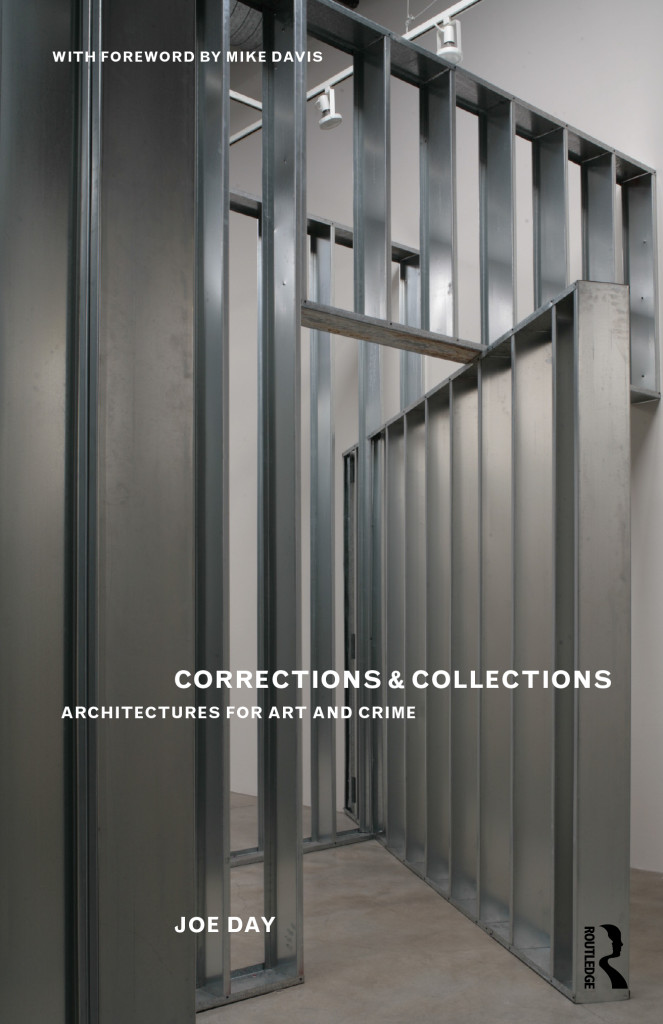
Corrections & Collections: Architectures for Art and Crime
A Book Talk and Signing
December 5, 7 p.m. Read More …
Different Kinds of Water Pouring Into a Swimming Pool, on view now at REDCAT through November 24, is the first solo project by Madrid-based architect Andrés Jaque / Office for Political Innovation in Los Angeles. Jaque, who is currently a professor at GSAPP Graduate School of Architecture, Planning and Preservation at Columbia University in New York, sidesteps conventional notions of architecture, preferring to make work that stirs up questions around community, consumption, and political engagement. His work, IKEA Disobedients, which was performed at MoMA PS1 in New York was recently acquired by the Museum of Modern Art of New York (MoMA) as the first “architectural performance piece” in its collection. Read More …
The Solar Decathlon took place in early October in spite of the government shutdown that furloughed all but the most essential employees at the U.S. Department of Energy (DOE), which organizes the biennial competition. Fortunately, the decathlon was funded during the previous fiscal year and is also supported by private donors. But there was another reason the fiscal battle in Congress barely cast a shadow over the proceedings: For the first time since its founding in 2002, the decathlon wasn’t held on the National Mall in Washington, D.C., but rather at the Orange County Great Park in Irvine, Calif. Read More …
Across our diverse fields we are tackling the question of how to better engage the bottom-up-open-source-distributed-tactical-informal-crowd phenomena surrounding us, whether in the service sector, the city, or the networked community. Read More …
The U.S. pavilion at the 2012 Venice Architecture Biennale featured American designers and artists deploying improvisational and even guerrilla tactics to make cities more sustainable, accessible, and inclusive. Hear from three of those artists whose works used heritage to create new opportunities and amenities for the public. From symbolic to practical, physical to virtual, whimsical to serious, these projects explore the interplay between unsanctioned and official, and suggest fresh tactics for engaging the public and revitalizing communities.
Mimi Zeiger, architecture journalist and critic
Richard Saxton and Stuart Hyatt, Campito, The M12 Collective
Graham Coreil-Allen, New Public Sites
Shaun Slifer, The Howling Mob Society
How many women? That’s the question I routinely ask when faced with a lineup of panelists, a competition jury, an exhibition checklist, or a table of contents. Then I will count, picking out female names and remembering which offices are partnerships.
I’m not alone in my inventory. For (en)Gendered (in)Equity: The Gallery Poster Project, Micol Hebron asked fellow artists to contribute posters depicting the numbers of male and female artists represented by top galleries in Los Angeles. Read More …
Advisory Board Member and Respondent
In 2030, the world’s population will be a staggering eight billion people. Of these, two-thirds will live in cities. Most will be poor. With limited resources, this uneven growth will be one of the greatest challenges faced by societies across the globe. Over the next years, city authorities, urban planners and designers, economists, and many others will have to join forces to avoid major social and economical catastrophes, working together to ensure these expanding megacities will remain habitable.
To engage this international debate, Uneven Growth brings together six interdisciplinary teams of researchers and practitioners to examine new architectural possibilities for six global metropolises: Hong Kong, Istanbul, Lagos, Mumbai, New York, and Rio de Janeiro. Following on the same model of the MoMA exhibitions Rising Currents and Foreclosed, each team will develop proposals for a specific city in a series of workshops that occur over the course of a 14-month initiative.
Uneven Growth seeks to challenge current assumptions about the relationships between formal and informal, bottom-up and top-down urban development, and to address potential changes in the roles architects and urban designers might assume vis-à-vis the increasing inequality of current urban development. The resulting proposals, which will be presented at MoMA in November 2014, will consider how emergent forms of tactical urbanism can respond to alterations in the nature of public space, housing, mobility, spatial justice, environmental conditions, and other major issues in near-future urban contexts.
Urban Case Study Teams:
New York: Situ Studio, New York, and Cohabitation Strategies (CohStra), Rotterdam
Rio de Janeiro: RUA Arquitetos, Rio de Janeiro, and MAS Urban Design ETH, Zurich
Mumbai: URBZ, Mumbai, and Pop Lab, Massachusetts Institute of Technology (MIT), Cambridge
Lagos: NLÉ Architects, Lagos, and Inteligencias Colectivas, Madrid
Hong Kong: MAP Office, Hong Kong, and Network Architecture Lab, Columbia University, New York
Istanbul: Superpool, Istanbul, and Atelier d’Architecture Autogérée, Paris
When talking about workplace design, the buzzword “collaboration” flies around the tech world faster than a speeding foosball. From startups working out of garages to sprawling corporate campuses, everyone is looking to harness the creative energy of people working together. Pinterest is no exception. The design-driven company is using its new 45,000-square-foot headquarters in San Francisco’s SoMA neighborhood as a test site for collaboration. Read More …
For an exhibition about architectural projects that never broke ground, there’s something rather cheery about Never Built: Los Angeles, on view at the A+D Museum through October 13. Outside, an oversized lenticular facade is a shade of yellow that shouts Southern California—it’s all citrus groves and sunshine. A billboard-sized image of the Cadillac-like Goodell Monorail is frozen mid-zoom along Wilshire Boulevard. Inside, a map of the Los Angeles Basin stretches out across the gallery floor. Sam Lubell and Greg Goldin have brought together a selection of unrealized works, many of which, if built, had the potential to change our understanding of the city. For the curators “what if” is not a lament, per se, but rather a celebration of speculative possibilities and a challenge to the present status quo. Read More …