Mimi Zeiger

Critic, editor, curator and instigator.

The Chatter Chat series are salons held in conjunction with the Architecture and Design Department’s exhibition Chatter: Architecture Talks Back that use the exhibition as a platform to discuss critical issues in the field of contemporary architecture.

This Chatter Chat invites two architects and a writer, all of whom are featured in the exhibition, to frame their projects relative to history (as a precedent and as an element to build upon), as well as discuss the productive ways in which architecture can be communicated. Each panelist presents their work through this lens as a prompt for discussion among a panel of Chicago-based architects and scholars, offering up insights for questions such as:

How do architects summon the material, formal, and sociocultural lessons from history without being beholden to them?
How do we reframe architecture through history’s most valuable architectural inheritances?
How does communication advance architectural representation and discussion?
Can architecture be communicated in a way that goes beyond the approved (but void-of-content) press release?
Can it empower, challenge, reveal, critique, reinterpret, and diagnose the discipline and our times?

Presenters
Erin Besler, University of California Los Angeles
Urtzi Grau, Fake Industries Architecture Agonism
Mimi Zeiger, critic, editor, curator, and instigator

Interlocutors
Grant Gibson, CAMES/Gibson
Ellen Grimes, School of the Art Institute
Jonathan Mekinda, UIC
Agata Siemionow, Illinois Institute of Technology

Moderator
Iker Gil, director of MAS Studio and editor in chief of MAS Context

Exhibition catalogue launch and signing follows the roundtable discussion.
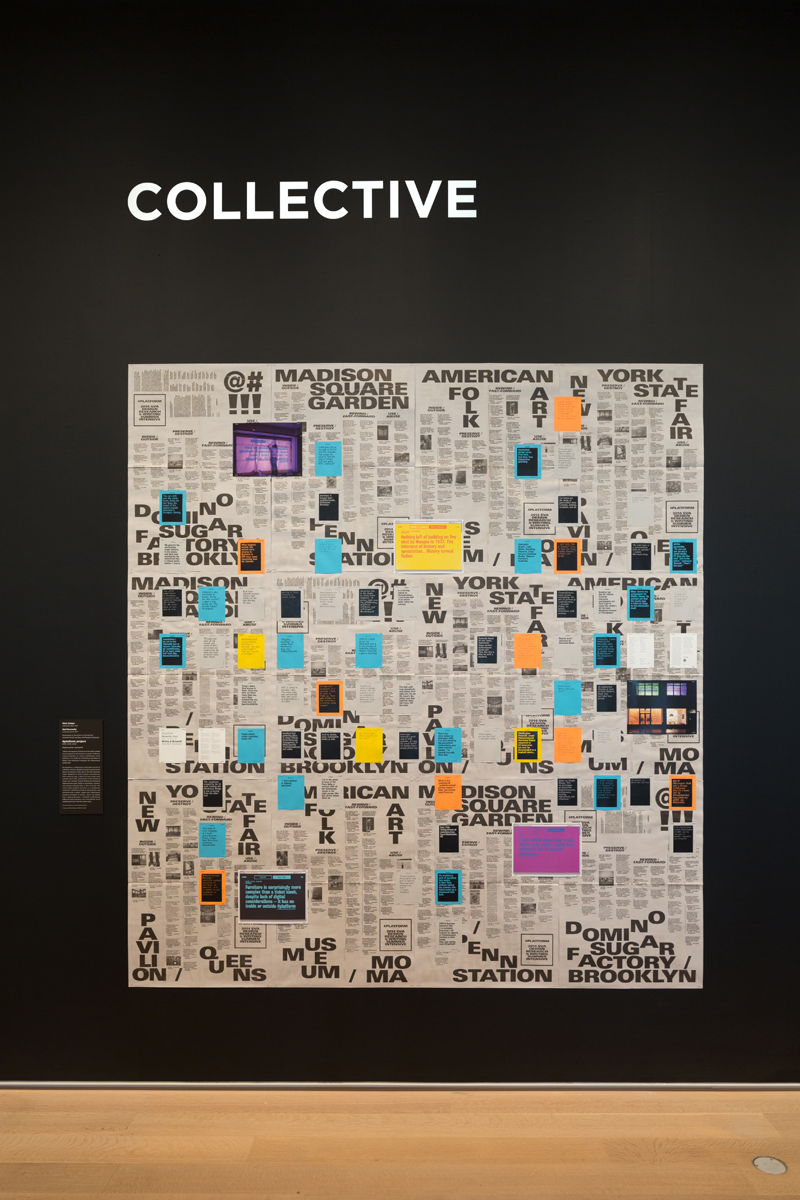
Curators: Karen Kice, with Iker Gil

Mimi Zeiger and Neil Donnelly with the School of Visual Arts Summer Design Writing and Research Intensive

Architecture is a perpetual conversation between the present and the past, knowing full well that the future is listening. So what happens when this dialogue is influenced by contemporary modes of communication such as texting, Twitter, and Instagram? Chatter happens: ideas are developed, produced, and presented as open-ended or fragmented conversations and cohere through the aggregation of materials. Chatter: Architecture Talks Back looks at the diverse contemporary methods and approaches wielded by five emerging architects: Bureau Spectacular, Erin Besler, Fake Industries Architectural Agonism, Formlessfinder, and John Szot Studio. Read More …

Taking cues from the French philosopher Emmanuel Levinas, architect Tatiana Bilbao frames her practice around the ethics of the “other,” a deep-seated philosophy and an almost moral compulsion to make architecture that puts the human subject first. It’s an idealist position, perhaps even old-fashioned, at a time when architecture’s social agenda is all too often shortchanged for formal hijinks. Indeed, Bilbao, who is in her early forties, began her career alongside other Mexican architects vying for the global stage, such as Fernando Romero, her friend and former business partner, who, with the swoopy shiny Soumaya Museum (2011), landed complex, computational architecture in Mexico City. Formally much quieter, Bilbao’s work carries its own powerful aesthetic — from early conceptual ideas to more recent projects such as the sensitive, light-flooded Tangassi funeral home in San Luis Potosi (2005–11) or the gleaming Bioinnova research building at the Monterrey Institute of Technology (2009–12) — and proves that architecture’s social responsibility doesn’t have to sacrifice beauty, materiality, or form. With 31 employees and projects in Belgium, China, France, Spain, and Switzerland, as well as her native Mexico, her namesake firm, which she runs with partners David Vaner and her sister Catia, is in high demand. But though she may have the schedule of a jet-setting “starchitect,” in person the mother of two small daughters is warm, down-to earth, and generous with the little time she has, sometimes to the point of exhaustion (just prior to the photo shoot for this issue, she was diagnosed with pneumonia). PIN–UP met Bilbao over a Peruvian lunch in downtown Los Angeles to talk about her interest in urban planning, her family history, and how working with Gabriel Orozco led to an architectural epiphany of sorts.

To read the full interview, download PDF here.

“The cavalry isn’t coming,” said indie movie director Mark Duplass, kicking off his keynote address at last month’s SXSW Film Festival.

I was in Austin, Texas, for a panel on architecture and civic participation with Mexico City architect Michel Rojkind and local technologist Leslie Wolke as part of SXSW Interactive. At SXSW, film and interactive run simultaneously the week before the famous music festival gets loud. And although design was somewhat of a running theme on the tech side, with talks by design world thought leaders Paola Antonelli and John Maeda as well as dozens of sessions with design in the title, I found myself drawn to the conversations happening in film. Read More …

“Can architecture serve as a way to reconnect parts of the city or enhance human experience?” asks architect Michel Rojkind, founder of Mexico City–based Rojkind Arquitectos. Although the sharing economy recalibrated how we interface with the city through apps and services, the design of buildings and public spaces are still largely conventional. So, how to design for better civic engagement? In conversation with architect Michel Rojkind, writer Leslie Wolke, and architecture critic Mimi Zeiger will explore recent experiments at the intersection of architecture, interaction design, and urban intervention: from a department store in Mexico City wrapped in a 10-foot-deep layer of programmable hexagonal pods to mobile structures in Madrid that transform historical spaces. What do these urban interventions mean to us as technology and architecture intermingle in unfamiliar ways?

When news of the demolition of sci-fi master Ray Bradbury’s former home by none other than Pritzker Prize-winning architect Thom Mayne hit the internet last month, literary fans, preservationists, and even LA Times architecture critic Christopher Hawthorne mourned the loss of a piece of cultural history.

Bradbury, who passed away in 2012, lived in the house for fifty years and wrote from his basement office. His 1937 Old Yellow House located in the Los Angeles neighbourhood of Cheviot Hills, bore no visual hint of the author’s dystopian fictions.

“I could make no connection between the extraordinary nature of the writer and the incredible un-extraordinariness of the house. It was not just unextraordinary, but unusually banal,” Mayne explained in an interview with design journalist and radio host Frances Anderton.

It would seem, then, that the basic ordinariness of this modest residential structure was the root of its own undoing. By his account Mayne’s new design is an eco-friendly update on the Case Study house programme — the mid-century experiments in modern living that would define Californian Modernism. A potential departure from his techno-futurist oeuvre, his scheme will no doubt wow the neighbourhood with its distinctive form. But perhaps in using ordinary versus extraordinary as the rationale, we miss the potential of the deadpan or the banal. Read More …

Groundswell: Guerilla Architecture in Response to the Great East Japan Earthquake, which recently closed at the MAK Center for Art and Architecture, was a modest exhibition about a catastrophic event. Organized by the MAK’s director Kimberli Meyer, with input from Hitoshi Abe, the show documented several architectural answers to a seemingly impossible question: How might architecture—fragile, temporal, and arbitrary in the face of a 40-foot-high tsunami—offer, if not a solution, guidance to rebuild devastated communities? Read More …

Should architects design for torture? Of course not. The answer seems so clear, so unequivocally in line with the contemporary image of the architect as a just shaper of the society, a creative world citizen serving both client and public.

When we switch the question around, however, and ask if architects should curtail their involvement in designing certain spaces associated with prisons, specifically spaces intended for execution and prolonged solitary confinement, the answer becomes murky. Client-side alliances and post-occupancy reporting complicate the architect’s societal duty. Such restriction asks architects to take an ethical and human rights stance on ongoing practices that could be considered out of their control.

Read More …

On Monday, January 19, 2015, MAS Context and five LA-based contributors will provide a behind-the-scenes look at the publication and discuss the work they contributed. The event will be hosted at Bruce Mau Design Los Angeles.

Contributors:
Julia Luke (Creative Director, Julia Luke Design)
Deborah Richmond (Architect, Deborah Richmond Architects)
Joshua G. Stein (Architect, Radical Craft)
David Yoon (Engineer, YoonCo)
Mimi Zeiger (Critic, editor, curator and instigator)

Moderated by Iker Gil (Editor-in-chief, MAS Context) and Andrew Clark (Director, BMD Los Angeles).

Barbara Bestor (architect and executive director of the Woodbury University Julius Shulman Institute) moderates a panel on the critical and engaged eye that photographers bring to the built environment. In LA the human experience of space has undergone constant transformation and we will discuss the urban environment and its changing representations.

Moderator: Barbara Bestor: Architect and Executive Director of the Woodbury University Julius Shulman Institute

Panelists:
Frances Anderton: Producer, Writer & Host of DnA, Design & Architecture, KCRW
James Welling: Artist & Professor of Photography, UCLA Department of Art
Mimi Zeiger: Critic, Editor & Writer
Grant Mudford: Photographer
Gordon Baldwin: Independent Curator, Writer & Editor, Former Curator
Department of Photographs, Getty Museum