At 95, the dancer, choreographer and activist Anna Halprin has no time for nostalgia. Last summer she celebrated her birthday with a performance on the dance deck at her home in Marin County. Bare feet on redwood boards, white hair framed against the pine trees beyond, she was as present and lively as when her late husband and collaborator, the landscape architect Lawrence Halprin, first built the deck for her in 1954. Read More …
“If all possible old building stock in Los Angeles was converted to creative office space, that still wouldn’t meet the demand for creative offices,” a commercial real estate broker once explained to me.
At the time, his company was trying to crack the workplace code: how to cater to the technology sector’s voracious taste for converted industrial warehouses and lofts? Established tech companies and startups alike had aligned the rough-and-ready aesthetics of the artist studio with the well-worn terms of Silicon Valley – disruption, innovation, and flexibility. Read More …
Until recently most Angelenos likely regarded tiny houses — residences as small as 70 square feet — with bemusement, as fodder for cable TV series or design magazines. Last month, however, tiny houses became a social justice cause when the city seized three that had been donated to people who are homeless.
Boxy and brightly painted, with wheels, lights and a lockable door, these particular crowdfunded shelters were constructed by Los Angeles resident Elvis Summers and provided to homeless people in South Los Angeles as a step up from the tents and tarp settlements that now dot the city. His act of good samaritanship has sparked a debate among city officials, activists, homeless individuals, and neighborhood residents over whether tiny houses are blight or salvation. Read More …
Shelter. Let’s start there. It’s a basic need. The root of architecture— Marc-Antoine Laugier’s enlightenment frontispiece offers up the primitive hut as reason over nature. A right, right? We’d like to think so. But globally and nationally, the simplest of human acts of shelter are elusive, politicized, and pushed to extremes. In architecture building types conventions split along economic lines: house versus housing. The former is a client-driven expression of taste, while the latter requires a systematic juggling of multiple units and services. Read More …
Last month, LACMA announced that James Goldstein — an eccentric personage familiar courtside at Lakers games — had promised his iconic John Lautner–designed home to the museum. The gift, which includes $17 million (£12.1 million) for preservation and maintenance, was widely reported along with the well-known piece of pop cultural trivia, that the house was featured in a Coen brothers’ film — as summed up with one clickbait headline: The Porn House From The Big Lebowski Has Been Donated to a Museum. Read More …
Nearly a month after Denise Scott Brown and her husband and partner Robert Venturi received the 2016 AIA Gold Medal and a few days before the RIBA awarded Zaha Hadid the 2016 Royal Gold Medal, I get on the phone to outspoken curator and architect Eva Franch i Gilabert, director of New York City’s Storefront for Art and Architecture. I explain I’m writing a piece about women in architecture. Read More …
Architecture of Life. There’s nothing retiring about the ambitious title of the inaugural exhibition of The University of California, Berkeley Art Museum and Pacific Film Archive (BAMPFA). When the new building by Diller Scofidio + Renfro opens at the end of January, the sweeping survey curated by museum director Lawrence Rinder will fill all of the galleries with an imaginative, interdisciplinary, and international collection of some 250 works drawn from art, architecture, and science. Read More …
Read an interview with Mimi in the Los Angeles Times.
Feature in Dwell Magazine.
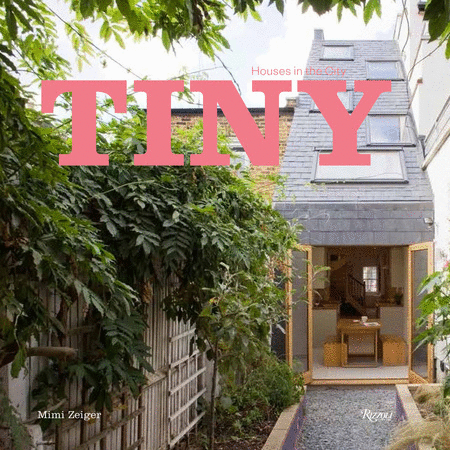
A presentation of micro-scaled contemporary residences that demonstrate domesticity can be both compact and beautiful. How we live in cities—smaller, denser, smarter—is at the heart of Tiny Houses in the City. Urban areas across the globe are experiencing a renaissance, with once-forgotten downtowns and neighborhoods becoming increasingly popular for redevelopment. This book looks at the tiny house movement through the lens of metropolitan life. Tiny Houses in the City features an international collection of more than thirty homes that exemplify compact living at its best. The houses, apartments, and multifamily buildings and developments included make great architecture out of challenging locations and narrow sites. Focusing on dwelling spaces all under 1,000 square feet, Tiny Houses in the City illustrates strategies for building tiny in urban areas that include urban infill, adaptive reuse, transforming and flexible living spaces, and micro-unit buildings. The projects range from a 344-square-foot studio apartment in Hong Kong with movable walls, transformable furniture, and hidden storage that can be configured into twenty-four unique scenarios in a single space, to a townhouse-like London residence built in an old alley between two stately homes. Many of the residences chronicled in Tiny Houses in the City are indeed unique in design, but their economical size and ingenious interior spaces are the epitome of practicality and illustrate an acute understanding of compact living and its potential for the urban realm.
A collaboration between Mimi Zeiger and Neil Donnelly
#platform is both a means of production and a place to take a stand.
#platform project is a collaborative publication and act of collective criticism.
#platform’s physical documents navigate back into the city, lingering as messages.
For the past four years, participants in the School of Visual Arts Summer Design Writing and Research Intensive in New York have used Twitter to document, research, and critique the city. The social media platform acts as a productive constraint, distilling individual observations and narratives into a public, digital text. Read More …
The Petersen Automotive Museum only reopened yesterday, but connoisseurs of Wilshire Boulevard architecture have been jawing about the eye-popping facade for months. Ever since a carapace of red steel ribbons started to appear, bending around the corner of Fairfax and arcing over the roof of the former Seibu department store, the structure designed by Kohn Pederson Fox has drawn pointed criticism.
Garbage. Obnoxious. Hideous. The Edsel of architecture. Facadism.
And ever since red LED lights were installed along the edge of each ribbon, turning every component of the facade into an undercarriage worthy of a Vin Diesel vehicle, we can add “traffic hazard” to the list. But is it enough to point out the offensive and offer revved up reproach – a model of critique custom-made for our digital lives? After the retorts cool, the museum opens, and we have to live with the eyesore, one wonders if KFP’s design offers any lessons for our architectural now?